Formal styling for big and tall men: Complete guide

Table of Contents
- Understanding body proportions and vertical balance
- Best suit fit for big and tall men: Key measurements and silhouette
- Choosing the right fabric and construction for larger frames
- How to style waistcoats for formal events and weddings
- Formal wear accessories for men: Completing your look
- Professional tailoring and custom fit solutions
- Colour coordination and confidence at formal occasions
- Frequently Asked Questions
Last Updated: September 27, 2026
Understanding body proportions and vertical balance
For big and tall men, formal styling requires understanding how proportions work on a larger frame, accounting for vertical length, shoulder width, and fabric drape, to create visual balance.
The core principle: clothes should elongate your frame rather than add bulk. A jacket reaching the middle of your hand with trousers breaking once at the shoe creates a clean vertical line that makes you look taller and composed.
Start with vertical proportions first. If a standard suit jacket ends too high, it's the wrong jacket; no tailoring fixes that mismatch. A proper break at the top of your shoe is equally critical.
Best suit fit for big and tall men: Key measurements and silhouette
The ideal suit starts with accurate measurements across five key areas: shoulder width, jacket length, chest circumference, waist suppression, and trouser inseam.
Shoulder width determines everything else. If the seam sits past your natural shoulder point, the jacket collapses; if too narrow, you fight the fabric. For larger frames, choose conventional or slightly relaxed shoulders with soft-structured construction for comfort during extended wear.
Jacket length should hit the middle of your hand when arms hang naturally, typically around 33 to 34 inches for tall men. Trouser break should be clean and deliberate: one break at the shoe, not two.
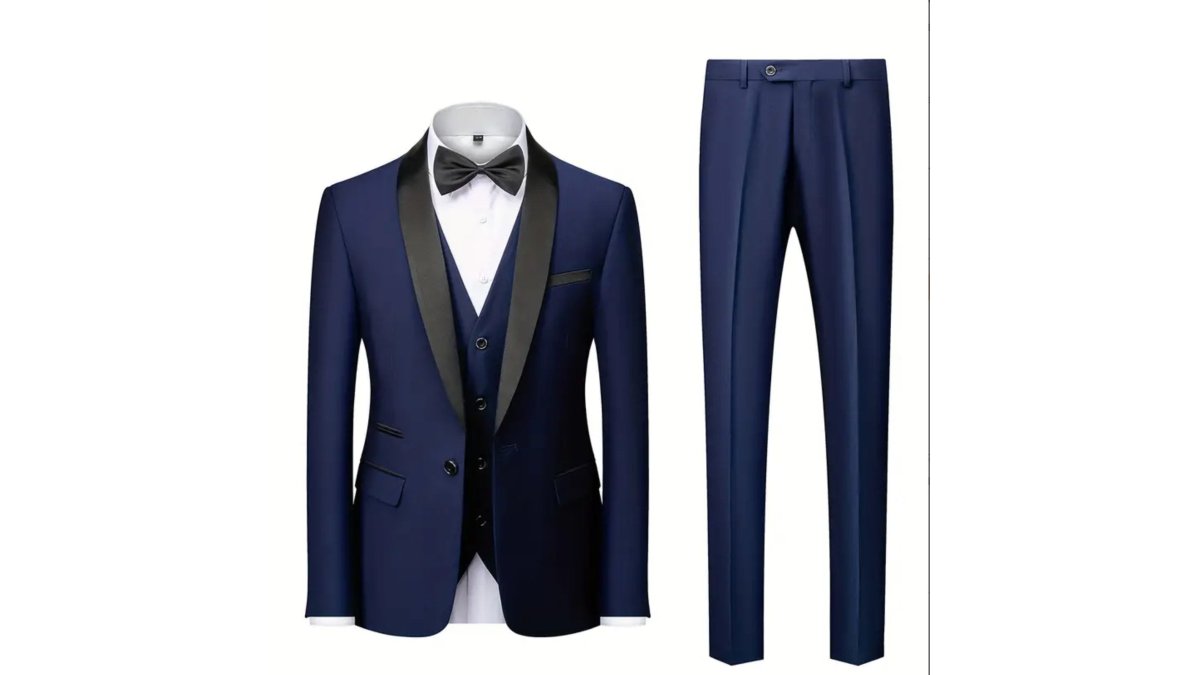
Look for jackets with moderate waist suppression built in to create visual shape without extreme tailoring. SimonVon Shop's three-piece suits, like the Navy Blue Men's Elegant 3pcs Suit ($230.00), include a vest that adds structure and visual interest for intentional silhouette control.

| Measurement | What It Controls | Target Range |
|---|---|---|
| Shoulder width | Jacket fit at top | Match your natural shoulders exactly |
| Jacket length | Proportional balance | Middle of hand when arms hang |
| Trouser inseam | Vertical line | Single break at shoe top |
| Chest circumference | Breathing room | Approximately 5-8 cm of ease |
| Waist suppression | Visual shape | Moderate (not extreme) |
Aim for a clean, vertical silhouette. Avoid oversized lapels, wide notches, or boxy cuts; they read as dated and add weight. Narrow to medium lapels work better on larger frames.
Choosing the right fabric and construction for larger frames
Fabric choice matters for extended wear. A polyester-viscose blend offers structure and airflow, with viscose adding drape that helps fabric fall smoothly on larger frames rather than cling or billow.
Heavier woven fabrics hold shape better throughout the day, resisting wrinkles and maintaining crisp lines, essential for formal events.
Stretch fabrics relax slightly during wear, affecting crispness by evening. For formal events, non-stretch woven suits maintain sharp lines better. SimonVon Shop's Men's 3-Piece Suit Set with slight stretch in burgundy ($230.00) balances comfort and structure.

Darker colours, navy, charcoal, black, create visual continuity and minimise volume. Lighter colours and patterns draw attention and can make larger frames appear bulkier. For most formal events, stick with neutrals.
How to style waistcoats for formal events and weddings
A waistcoat adds visual structure, creates a defined waistline, and provides a third layer for colour and pattern. For larger frames, it's nearly essential at formal events.
A waistcoat should be snug through the torso without restricting breathing, with the bottom button at or just above your natural waistline.
Colour coordination is where most men play it safe and miss an opportunity. A matching three-piece suit is safe, but a contrasting waistcoat creates visual interest. Navy jacket with a burgundy waistcoat, or charcoal with a deep grey waistcoat, signals intentionality. Just avoid clashing patterns; if your waistcoat has texture or pattern, keep your shirt and tie solid. If your shirt has a subtle pattern, keep the waistcoat and tie solid.
Men's 3-Piece Suit Set -Slim Fit with →
The waistcoat should disappear into the jacket at first glance, visible only when you move or remove the jacket. This means it shouldn't extend below the jacket hem. The lapels should sit flat against your chest, not pull or gap.
SimonVon Shop specializes in waistcoats and vest sets, recognizing that formal styling for big and tall men needs dedicated options. A well-fitted waistcoat from their collection transforms how a suit reads on your frame; it adds intentional structure rather than bulk.
Formal wear accessories for men: Completing your look
Accessories are where confidence lives. A man in a perfectly fitted suit but wearing a clip-on tie looks uncomfortable. A man in the same suit wearing a properly tied silk necktie with a pocket square and cufflinks looks composed and intentional. Accessories matter.
Start with the tie. For formal events, silk is non-negotiable. It has a natural sheen that catches light properly and drapes with weight and intention. Width matters too; a narrow tie looks dated on larger frames, but an oversized tie reads as costume. Aim for a tie width that's proportional to your lapel width. Most formal lapels work with a tie between approximately 8.25 cm and 9.5 cm wide.
Colour coordination follows a simple rule: the tie should bridge your jacket and shirt. If you're wearing a navy jacket and white shirt, a burgundy or forest green tie connects them. A pocket square adds another layer; it can match the tie, complement it, or introduce a subtle pattern. Many men skip pocket squares thinking they're fussy. They're not. They signal that you've thought about your appearance.
Cufflinks are essential for formal wear. They replace buttons on French cuff shirts and immediately elevate your look. Choose simple, understated styles; mother-of-pearl, silver, or subtle enamel designs work everywhere. Avoid anything flashy or novelty. The goal is to look like you belong at the event, not like you're trying too hard.
The shirt itself deserves attention. A crisp white or light blue dress shirt is the foundation. For formal events, the collar should be a spread or point collar, not a button-down.
| Accessory | Purpose | Formal Standard |
|---|---|---|
| Silk tie | Colour bridge | Approximately 8.25-9.5 cm wide |
| Pocket square | Visual interest | Complements or matches tie |
| Cufflinks | French cuff closure | Simple, understated design |
| Dress shirt | Foundation layer | Spread or point collar |
| Leather shoes | Grounding element | Oxfords or dress shoes |
Professional tailoring and custom fit solutions
Off-the-rack suits rarely fit perfectly without tailoring. For big and tall men, tailoring isn't optional; it's essential. The difference between a suit that fits and one that's tailored is the difference between looking competent and looking composed.
Colour coordination and confidence at formal occasions
Colour choice affects how you feel as much as how you look. The right colours make you feel composed and intentional. The wrong colours make you second-guess yourself all night.
Frequently Asked Questions
How should a suit fit for a big and tall man?
A well-fitting suit for big and tall men should have jacket sleeves reaching your wrist bone, shoulders sitting naturally without bunching, and a jacket length that covers your backside. Trousers should have a slight break at the shoe, about 1-2 centimetres of fabric touching the top of your shoe. The waist should sit comfortably without pulling or gaping. Proper fit prevents the silhouette from appearing oversized and creates vertical balance that flatters your proportions.
What are the best fabric choices for formal wear for larger frames?
Choose fabrics with natural breathability and subtle drape, such as polyester-viscose blends that offer structure without bulk. Avoid heavy, stiff materials that add volume. Fabrics with slight stretch (like those in SimonVon Shop's 3-piece suits) provide comfort and movement without compromising formal appearance. Matte finishes work better than shiny ones, as they don't emphasise width. Quality construction with proper lining ensures the suit hangs well on your frame.
How do I choose the right waistcoat for a big and tall build?
Select a waistcoat that follows your suit's silhouette without adding extra volume. A properly fitted waistcoat should sit at your natural waist, with buttons positioned to create vertical lines that draw the eye upward. Avoid oversized armholes or loose cuts. Solid colours or subtle patterns work better than busy designs. The waistcoat should complement rather than compete with your jacket; consider coordinating it as part of a three-piece suit set for cohesive styling at weddings and formal events.
Are there specific formal wear accessories that flatter larger men?
Yes, choose ties with subtle patterns or solid colours that complement your suit. Pocket squares, cufflinks, and tie clips add polish without bulk. Opt for proportional accessories. Quality leather footwear in black or dark brown grounds your look and creates visual balance.
What's the difference between off-the-rack and tailored suits for big and tall frames?
Off-the-rack suits offer affordability and immediate availability, but rarely fit perfectly without adjustments. Professional tailoring adjusts sleeve length, jacket length, trouser inseam, and waist suppression to your exact measurements. For big and tall men, tailoring is often essential to achieve proper proportions and avoid an oversized appearance. Many formal wear pieces from SimonVon Shop, such as the 3-piece suit sets, benefit from professional tailoring to ensure the best fit and silhouette.
How do I coordinate formal outfits for a wedding party with varying sizes?
Choose a consistent suit style, colour, and fabric across all members, then tailor each suit individually to fit properly. Ensure all waistcoats, ties, and accessories match in colour and quality so the group appears cohesive despite size differences. Brief all groomsmen or guests on fit standards: shoulders should align, jacket lengths should be proportional, and trousers should have consistent breaks. Coordinating through a single retailer like SimonVon Shop simplifies this process and ensures consistency in quality and appearance.