
Formal Tie Bars for Weddings: Complete Guide

Table of Contents
- What Makes a Tie Bar Formal
- Tie Bar and Cufflink Sets for Complete Wedding Styling
- How to Wear a Tie Bar: Placement and Positioning
- Tie Bar Size Guide: Length, Width, and Proportions
- Groom and Groomsmen Accessories: Coordinating Your Wedding Party
- Choosing Tie Bar Finishes and Materials for Formal Occasions
- Frequently Asked Questions
Last Updated: October 6, 2026
What Makes a Tie Bar Formal
Formal tie bars weddings elevate your dress shirt and necktie into a polished, intentional ensemble. The best formal tie bars for nz weddings secure your tie whilst signalling attention to detail.
Formality comes down to three elements: material, finish, and design restraint.
The clip mechanism also defines formality. A secure clip that grips both the tie and shirt placket without slipping demonstrates quality craftsmanship; cheaper bars with weak clips shift during the day, undermining the whole point of wearing one.
At SimonVon Shop, we stock cufflink sets that pair elegantly with formal neckties and dress shirts. The key difference between a formal tie bar and a casual one is restraint, let the metal quality and fit do the talking.
Tie Bar and Cufflink Sets for Complete Wedding Styling
Formal tie bars weddings demand coordination across every visible accessory. A tie bar alone looks incomplete, pair it with matching cufflinks and a pocket square for a polished look that photographs well.

Coordinated sets simplify decision-making: a matched set ensures the metals, finishes, and design language align, separating a well-dressed groomsman from someone who threw together random pieces.
SimonVon Shop offers tie and cufflink sets starting at $34.50, each including a necktie, matching pocket square, and elegant cufflinks. The Red Silk Tie Pocket Square Cufflinks Set features a classic floral pattern in high-quality silk, ideal for formal daytime weddings or evening receptions. The Gold Paisley Tie Pocket Square Cufflinks Set works beautifully for grooms and groomsmen seeking warmth and sophistication without veering into statement territory.

For weddings with darker dress codes, the Dark Green Novelty Woven Tie Pocket Square Cufflinks Set offers classic plaid styling in premium polyester, durable and easy to maintain.

The advantage of a complete set is consistency: all groomsmen wear the same metal finish, design language, and quality, and this visual unity photographs beautifully.
How to Wear a Tie Bar: Placement and Positioning
Placement determines whether a tie bar looks intentional or accidental. The correct position is horizontal, spanning the width of your necktie, between the third and fourth buttons of your dress shirt.
This placement anchors your tie to your shirt placket, preventing it from swinging or shifting, and creates a visual line that elongates your silhouette in formal photography.
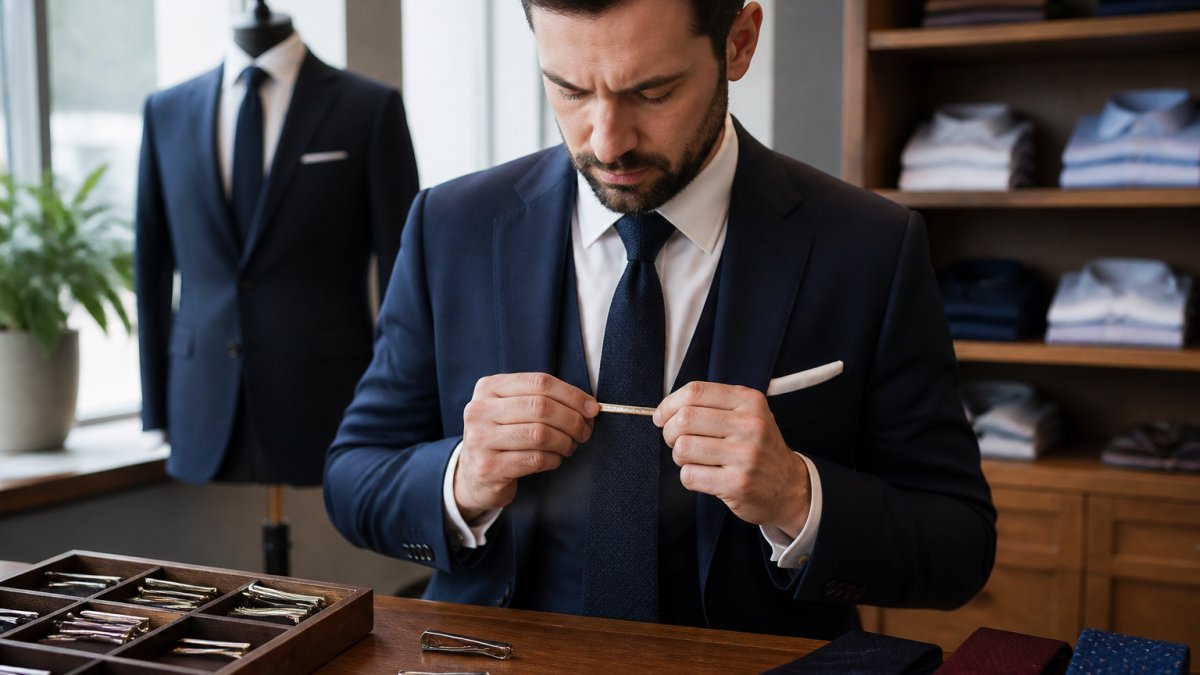
A simple placement rule
One rule to remember: the tie bar should sit at roughly the midpoint between your collar and your belt buckle, on most men, about 15-18 cm down from the top of the collar, landing between the third and fourth shirt buttons.
Never position a tie bar too high (second button) or too low (below the fifth). The third-to-fourth button zone is the sweet spot for formal occasions.
Getting the width right
The bar should span most of the visible tie width but not extend past the tie's edges. With a standard 8-9 cm necktie, a 4-5 cm bar covers roughly half to two-thirds of the tie face, which reads as deliberate; narrower looks undersized, wider looks oversized and can catch on jacket lapels.
The bar must also sit flat across the shirt placket. A 4-5 cm bar sits neatly within a standard 6-7 cm dress-shirt placket; on a slim placket, a shorter bar keeps proportions balanced.
Testing the grip before the ceremony
The clip should grip both the necktie and the dress shirt placket firmly. Test the grip before the ceremony: if the bar slides or rotates when you move your shoulders, the clip isn't tight enough.
Clip the bar on, then gently tug the tie downwards and sideways; it should not shift more than a few millimetres. If it does, the clip tension is too weak or you've positioned it over a single layer of fabric.
Common placement mistakes at weddings
- Angling the bar. For weddings, avoid tilting the tie bar at an angle. Angles are playful and casual. Formal occasions call for a perfectly horizontal bar that says you've thought through every detail.
- Clipping only the tie. The bar should always capture the shirt placket as well, otherwise the tie can still swing and the bar can rotate.
- Placing it under the jacket lapel line. If your jacket is buttoned, the bar should sit below the lapel notch so it remains visible when the jacket is open.
- Wearing it with a waistcoat. If you are wearing a waistcoat, the tie bar is usually hidden and can be omitted, or worn lower so it sits just above the waistcoat line.
Placement across the wedding party
For groomsmen of different heights, the button rule stays the same but the absolute measurement varies. Ask each person to find their own third-to-fourth button zone rather than measuring from the collar, so the bars sit at a consistent visual height across the group. A 4-5 cm length works across most adult frames; taller groomsmen with wider ties may prefer the upper end.
Tie Bar Size Guide: Length, Width, and Proportions
Tie bar dimensions matter more than most men realise: too narrow looks insubstantial, too wide overwhelms your necktie and shirt.
The standard formal tie bar measures 4-5 cm long and 0.5-0.8 cm wide, in balance with a standard necktie (8-9 cm wide) and a dress shirt placket (6-7 cm across).
Most formal tie bars from SimonVon Shop, including sets like the Blue Plaid Mens's Tie Pocket Square Cufflinks Set (150 cm × 8.5 cm tie size) and the Silver Grey Plaid Necktie Pocket Square Cufflinks Set, follow these standard proportions.
Red Silk Tie Pocket Square Cufflinks Set-N-5198 →
A bar under 3 cm looks like an afterthought; one longer than 5 cm risks looking ostentatious. Stick to the 4-5 cm sweet spot for formal occasions.
| Tie Bar Dimension | Standard Range | Effect |
|---|---|---|
| Length | 4-5 cm | Balanced, formal appearance |
| Width | 0.5-0.8 cm | Proportional to necktie and shirt |
| Tie length | 150 cm | Fits most adult men without alteration |
| Placement height | Between buttons 3-4 | Professional, intentional positioning |
Groom and Groomsmen Accessories: Coordinating Your Wedding Party
Coordinating formal accessories across a wedding party creates visual unity and photographs beautifully. The groom and groomsmen don't need to be identical, but they should speak the same design language.
Start with a colour palette: if the groom wears silver-toned accessories, groomsmen should follow suit; if the bride's colours include gold accents, a gold-toned tie bar works across the party.
The Gold and Teal Men's Silk Tie Handkerchief Cufflinks Set offers warmth and sophistication for wedding parties seeking a departure from traditional silver or black.
For larger wedding parties, give the groom a slightly different tie bar, a more ornate design or unique colour, to distinguish his role, while groomsmen wear matching or coordinated sets.
Coordinating accessories across 4-8 groomsmen is simpler when you purchase complete sets from a single retailer. SimonVon Shop's tie and cufflink sets ensure every piece matches in metal finish, design language, and quality.
Choosing Tie Bar Finishes and Materials for Formal Occasions
The finish of your tie bar communicates formality instantly. Polished metals signal formal occasions; brushed finishes lean more casual. For weddings, polished or semi-polished is the safer choice.
Matching finish to suit and tie
Gold finishes (including rose gold and champagne gold) work for warm-toned suits and earth-toned neckties. Silver pairs universally with cool-toned suits and jewel-toned ties. Platinum or white-gold offers the most formal, understated option.
A simple way to decide: look at the metal on your watch, cufflinks, and belt buckle. Predominantly silver-toned means choose silver or platinum; gold-toned means choose gold. Mixing a gold tie bar with silver cufflinks reads as unintentional.
Materials and durability
The material beneath the finish matters for durability. Stainless steel holds a polish longer than base metals and resists tarnishing. Genuine gold plating over brass offers a warmer tone but requires more care. For wedding day wear and beyond, stainless steel is the practical choice.
Plated finishes can wear through at the clip's contact points with repeated use, revealing the base metal underneath. Stainless steel avoids this because the colour runs through the material. If you plan to wear the bar regularly, stainless steel or solid precious metal will outlast thin plating.
Polished versus brushed
Brushed finishes (slightly matte rather than mirror-polished) are trending in formal menswear and are less reflective, which some find more sophisticated. The trade-off: they show fingerprints and smudges more readily.
For weddings where you'll be photographed extensively, avoid highly reflective finishes that create glare in flash photography; a semi-polished or brushed finish photographs more gracefully.
Care and storage
Tie bars are small and easy to lose, so a dedicated box or pouch is worth having. Wipe plated and polished bars with a soft cloth after wear to remove skin oils. Avoid leaving them loose with keys or coins, as scratches are hard to polish out on plated surfaces. Sterling silver tarnishes and can be restored with a silver cloth; stainless steel generally needs only a wipe.
Budget and buying considerations
Price bands vary widely. Entry-level plated base-metal bars are inexpensive but may lose their finish with regular wear. Mid-range stainless steel offers the best balance of durability and cost for most wedding parties. Solid precious-metal bars are a long-term purchase rather than a one-event accessory.
When buying for a wedding party, check three things before ordering multiples:
- Fastening security. A spring-loaded clip with good tension is more reliable than a friction-fit or magnetic closure, which can slip on smooth silk ties.
- Return policy. If you are ordering several identical bars for groomsmen, confirm the retailer accepts returns or exchanges for unused items in case sizes or finishes need adjusting.
- Availability and shipping. For a wedding date, confirm stock levels and delivery timeframes so the whole party's accessories arrive together with time to spare for any swaps.
The Royal Blue Plaid Tie Handkerchief Cufflinks Set features 80% Silk, 20% Polyester construction. The cufflinks complement the tie without competing for attention, the mark of true formal styling.
Frequently Asked Questions
What is the best tie bar style for a formal wedding?
The best accessory for a formal wedding is a classic, understated design in metal finishes like polished silver or gold. A simple design without ornate details complements formal attire without competing with your suit and tie. Coordinated sets that include matching cufflinks and pocket squares, such as the Gold Paisley Tie Pocket Square Cufflinks Set at $34.50, ensure a cohesive formal look across all your accessories.
How wide should a tie bar be compared with a tie?
An accessory should be approximately two-thirds to three-quarters the width of your necktie. Most formal ties measure around 8-9 centimetres wide, so your accessory should span roughly 5-7 centimetres. This proportion keeps the accessory visible and functional without overpowering the tie itself. The Blue Plaid Tie Pocket Square Cufflinks Set features a standard 8.5 centimetre tie width, making it easy to select proportionally correct accessories.
Where should a tie bar sit on a tie?
Position your accessory horizontally across the tie, roughly between the third and fourth buttons of your dress shirt. This placement keeps the accessory in the formal zone of your outfit and prevents it from sliding down as you move throughout the day. Ensure the clip or bar sits flat against both layers of the tie for a secure, polished appearance. This standard placement works for all formal occasions, including weddings and black-tie events.
Can the groom and groomsmen wear matching tie bars?
Yes, matching accessories are an excellent way to coordinate the groom and groomsmen. Formal accessory sets include cufflinks and pocket squares in coordinated designs. Identical or complementary metal finishes across the wedding party create visual unity. Consider sets like the Red Silk Tie Pocket Square Cufflinks Set or the Gold and Teal Men's Silk Tie set, both at $34.50, which allow you to dress multiple members of your party in matching formal accessories.