
How to Choose a Waistcoat for a Three Piece Suit

Table of Contents
- Step 1: Nail the Waistcoat Fit Guide
- Step 2: Decide Between Matching vs Contrasting Waistcoats
- Step 3: Follow the Waistcoat Buttoning Rules
- Step 4: Select the Right Fabric and Construction for Your Three Piece Suit
- Step 5: Adjust for Body Type and Troubleshoot Common Fit Issues
- Step 6: Match Your Waistcoat to the Occasion
- Conclusion: Your Three Piece Suit Waistcoat Checklist
- Frequently Asked Questions
Last Updated: September 20, 2026
Step 1: Nail the Waistcoat Fit Guide
Getting the fit right is the single most important part of learning how to choose a waistcoat for a three piece suit. A waistcoat that fits well sits flat against your shirt, covers your trouser waistband, and never bunches when you move. Unlike a jacket, it has no sleeves or lapels to hide a poor fit, so every error shows.
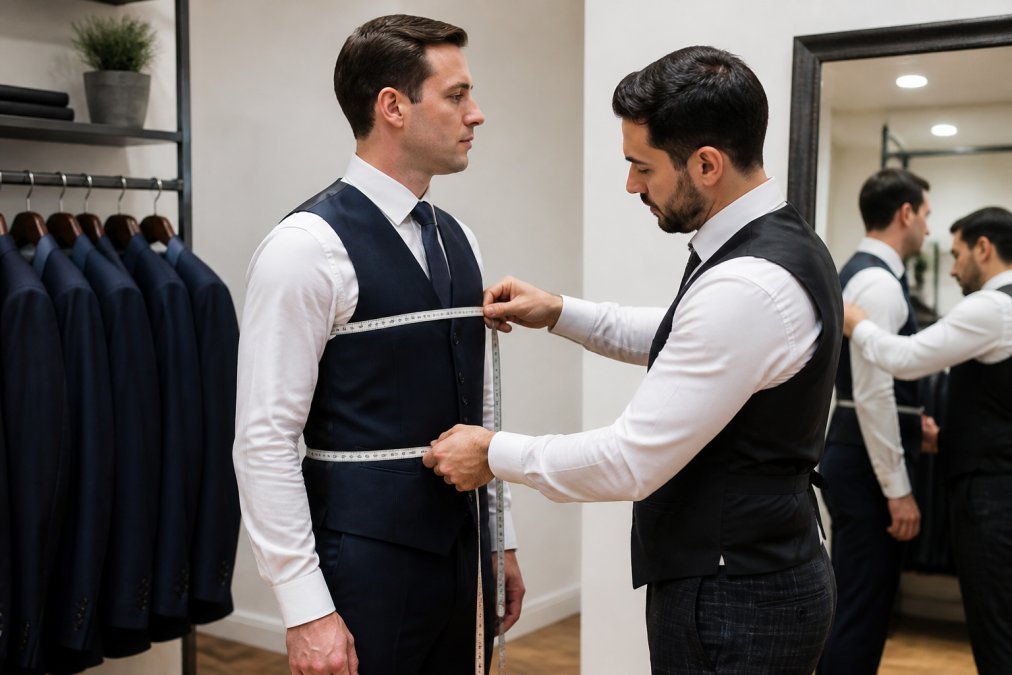
Measure before you buy
Waistcoats are cut closer to the body than jackets, so your vest size can differ from your suit size. Take two measurements with a soft tape:
- Chest: Measure around the fullest part of your chest, under the arms, keeping the tape level. Add roughly 5-7 cm of ease for a waistcoat that sits flat without pulling.
- Natural waist: Measure around the narrowest point of your torso, usually just above the navel. This is the number that decides whether the front will ripple.
The five-point fit check
- Chest: The front should sit flat with no pulling across the buttons. You should fit one finger under the fastened front.
- Waist: Snug, not tight. If the fabric ripples horizontally, size up.
- Length: The front hem should just cover your trouser waistband, even when you raise your arms. The back hem sits slightly lower than the front on a properly cut waistcoat.
- Armholes: High armholes let you move freely. Low ones dig into the armpit and expose shirt fabric when you reach forward.
- Shoulders: The seams should sit at the edge of your shoulder, not past it. A waistcoat that overhangs the shoulder will bunch under the jacket.
Tailoring for your build
Off-the-rack waistcoats are cut to an average torso, which is why body-type tailoring matters more here than on any other garment.
- Athletic or broad-shouldered builds: Look for a higher button stance and a slightly deeper V. This stops the chest from straining and gives the torso a longer line. You may need to size up and take in the waist.
- Slimmer frames: A snug fit with a higher button stance adds visual width to the chest. Avoid very deep V-necks, which make the torso look narrower.
- Bigger builds: Choose a longer front and a deep V. This stretches the silhouette and stops the fabric straining across the middle. A single-breasted waistcoat with a moderate button stance is more forgiving than double-breasted.
- Short torsos: A shorter waistcoat with a higher button stance avoids the hem sitting too low over the trousers.
Troubleshooting common fit issues
| Problem | Likely cause | Fix |
|---|---|---|
| Fabric pulls across buttons | Waistcoat too small | Size up or use the adjuster strap |
| Hem rides up when you move | Waistcoat too short | Choose a longer cut |
| Gaps at the armhole | Armhole too low | Try a higher armhole or made-to-measure |
| Bunching at the waist | Too much fabric | Take it in at the sides |
| Shoulders too wide | Wrong size | Size down or go bespoke |
| Back rides up | Back panel too short or adjuster too tight | Loosen the adjuster and check the back length |
A common pattern is that men buy a waistcoat tight across the chest hoping it will stretch. It will not, and the buttons will pull open the moment you sit down. If in doubt, size to the chest and have the waist adjusted.
Step 2: Decide Between Matching vs Contrasting Waistcoats
Matching vs contrasting waistcoats comes down to one question: do you want to blend in or stand out? A matching waistcoat in the same cloth as your jacket and trousers creates one clean line. A contrast waistcoat breaks that line and pulls the eye to your middle.


- Matching: Best for business formal, interviews, and conservative weddings. It reads as one complete three piece suit.
- Contrasting: Best for parties, gala events, and grooms who want a point of difference. Think a burgundy vest under a navy jacket.
- The safe middle: Match the waistcoat to your trousers, not your jacket, for a softer contrast.
Step 3: Follow the Waistcoat Buttoning Rules
The waistcoat buttoning rules are simple and never change: always leave the bottom button undone. This lets the fabric sit flat over your trouser waistband and stops the hem from flaring.
For a single-breasted waistcoat:
- Three buttons: Fasten the top two, leave the bottom open.
- Five or six buttons: Fasten all but the bottom one.
- Double-breasted: Fasten every button. These are cut to close fully.
Step 4: Select the Right Fabric and Construction for Your Three Piece Suit
Most guides stop at "wool is good, linen creases." The two decisions that actually determine how a waistcoat wears, fabric weight and internal construction, are almost never covered. This section claims that gap.
Fabric weight by season
Weight is measured in grams per square metre (gsm), and it decides how the waistcoat drapes, how it handles heat, and how long it lasts.
- Summer (around 200-260 gsm): Linen, cotton, or a lightweight wool. Linen breathes best but creases quickly, which is fine for a casual summer wedding but not for a formal event. A lightweight wool or wool-linen blend gives you breathability with fewer creases.
- Year-round (around 260-320 gsm): The sweet spot for most three piece suits. A mid-weight wool holds its shape, breathes well, and works from autumn through spring.
- Winter (around 320-400 gsm): Flannel, tweed, or a heavier worsted wool. These hold their shape, resist creasing, and add warmth under a jacket. Tweed is the classic choice for country or cold-weather events.
Construction: why it matters more than the label
Waistcoat construction falls into three types, and this is where most off-the-rack garments cut corners.
Men's 3-Piece Suit Set -Slim Fit with →
- Full-canvas: A layer of horsehair and wool canvas is stitched (not glued) between the outer fabric and the lining. It moulds to your body over time, drapes cleanly, and lasts for years. Found on made-to-measure and higher-end ready-to-wear.
- Half-canvas: Canvas through the chest and lapel area, fused (glued) below. A good middle ground, better drape than fully fused, lower cost than full-canvas.
- Fused: The outer fabric is glued to a synthetic interlining. Cheaper and faster to produce, but the glue can bubble or delaminate after repeated dry cleaning, and the waistcoat will not mould to your shape.
Details that signal quality
- Adjuster strap: A small buckle at the back lets you tighten the fit without a tailor. Almost every waistcoat has one, but a metal buckle with a fabric keeper lasts longer than a plastic one.
- Silk back and lining: A silk back lets the waistcoat slide under the jacket and breathes better than polyester. Polyester lining is cheaper and still works fine for occasional wear.
- Pattern matching at the seams: On a striped or checked suit, the pattern should line up across the centre front and the pocket welts. Misaligned patterns are the clearest sign of a cheaply made waistcoat.
- Lining: A full lining protects the outer fabric and helps the waistcoat slide over your shirt. Unlined waistcoats are cooler but wear faster.
For a reliable all-rounder, the Men's 3-Piece Suit Set in burgundy uses a polyester and viscose blend with slight stretch, which holds its shape while staying comfortable through a long event.

Step 5: Adjust for Body Type and Troubleshoot Common Fit Issues
Body type tailoring is where most off-the-rack waistcoats fail. The good news is that almost every common problem has a fix.
| Problem | Likely Cause | Fix |
|---|---|---|
| Fabric pulls across buttons | Waistcoat too small | Size up or use the adjuster strap |
| Hem rides up when you move | Waistcoat too short | Choose a longer cut |
| Gaps at the armhole | Armhole too low | Try a higher armhole or made-to-measure |
| Bunching at the waist | Too much fabric | Take it in at the sides |
| Shoulders too wide | Wrong size | Size down or go bespoke |
Step 6: Match Your Waistcoat to the Occasion
Occasion drives every other choice. A waistcoat that works at a black-tie gala will look wrong at a morning wedding.
- Weddings: Match the suit for a classic look, or contrast for the groom and groomsmen.
- Business formal: Keep it matching and understated. Navy, charcoal, or black.
- School balls: A contrast waistcoat in a bold colour is common and looks sharp with a slim suit.
- Black-tie galas: Go dark and refined. A black or midnight waistcoat with a silk back.
Victoria and Albert Museum guide to men's formal dress
Conclusion: Your Three Piece Suit Waistcoat Checklist
Choosing a waistcoat for a three piece suit is a short list of decisions, not a long one. Fit first. Then match or contrast. Then button it correctly and pick a fabric that suits the season and the event.
Before you buy, run this checklist:
- Chest fits flat with one finger of room
- Front hem covers your trouser waistband
- Bottom button left undone
- Fabric suits the season and occasion
- Adjuster strap present for a fine-tuned fit
Frequently Asked Questions
Does my waistcoat have to match my suit?
No, a waistcoat does not have to match your suit. For formal events like weddings, a matching waistcoat creates a seamless, traditional look. For more casual or creative settings, a contrasting waistcoat in a different colour or pattern can add personality. Just ensure the contrast is intentional and complements your shirt and tie.
What is the rule for the bottom button of a waistcoat?
The bottom button of a waistcoat should always be left undone. This tradition dates back to King Edward VII, who left his bottom button undone for comfort, and it became a style rule. Leaving it undone also prevents the waistcoat from pulling across your stomach and allows for easier movement.
How should a waistcoat fit compared to a suit jacket?
A waistcoat should fit closer to the body than a suit jacket. It should be snug but not tight, with no gaping at the buttons. The armholes should be high enough to allow movement without exposing your shirt. The back should sit smoothly, and the front should cover your trouser waistband when buttoned.
Can I wear a contrasting waistcoat with a three-piece suit?
Yes, you can wear a contrasting waistcoat with a three-piece suit, but it requires careful coordination. Choose a waistcoat in a complementary colour or pattern that ties in with your shirt or tie. For formal occasions, stick to subtle contrasts like grey with navy. For less formal events, bolder contrasts can work well.