
How to Fold a Silk Pocket Square: 6 Classic Folds

Table of Contents
- The Puff Fold: The Easiest Silk Pocket Square Fold
- The Presidential Fold (Flat Fold) for Formal Occasions
- The One-Point Fold: Simple, Sharp, and Symmetrical
- The Two-Point and Three-Point Folds: Adding Visual Interest
- The Four-Point Fold for Black-Tie and Galas
- How to Style a Silk Pocket Square with Your Jacket and Tie
- Pocket Square Folding Techniques for Weddings and School Balls
- How to Keep a Pocket Square in Place All Day
- Frequently Asked Questions
Last Updated: September 13, 2026
The Puff Fold: The Easiest Silk Pocket Square Fold
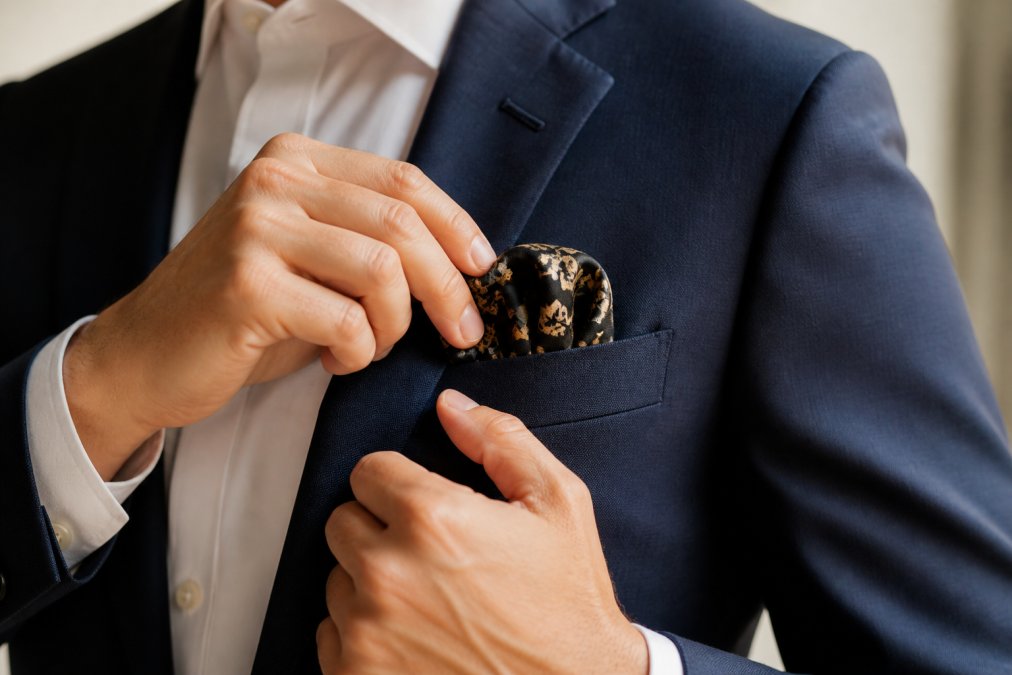
The puff fold is the most forgiving way to wear a silk pocket square. You pinch the centre of the fabric, gather it loosely, and tuck the rounded top into your breast pocket, leaving the edges to fan out naturally.
It works because silk drapes rather than holds a crease. A crisp fold fights the fabric; a puff lets the silk do what it does best.
Here's the method:
- Lay the square flat, patterned side down.
- Pinch the centre and lift, letting the corners hang.
- Slide your fingers down to form a loose ring.
- Tuck the gathered base into the pocket, leaving roughly 2-3 cm showing.
- Adjust the puff until it sits slightly asymmetrical.
This is the fold to learn first. It suits business casual, weddings, and any jacket where you want texture rather than precision.
The Presidential Fold (Flat Fold) for Formal Occasions
The presidential fold, also called the flat fold, produces a single clean horizontal line above the breast pocket. It's the most formal option and the safest choice for black-tie, boardrooms, and any setting where restraint matters.
Fold the square in half, then in half again, until you have a strip slightly narrower than your pocket. Leave a thin band of fabric visible, no more than 1 cm. The straight edge should sit level with the pocket line.
A common mistake is leaving too much showing. The presidential fold looks sloppy at 3 cm and elegant at 1 cm.
The One-Point Fold: Simple, Sharp, and Symmetrical
The one-point fold gives you a single triangle peak above the pocket. It's the middle ground between the softness of a puff and the strict line of a flat fold, and it reads as deliberate without being fussy.
Start with the square as a diamond. Fold the bottom corner up to meet the top corner, forming a triangle. Then fold the left and right corners inward so the base narrows to pocket width. Tuck it in with the point facing up.
Keep the point centred. A one-point fold that leans left or right looks like an accident, not a choice.
The Two-Point and Three-Point Folds: Adding Visual Interest
The two-point and three-point folds build extra peaks by offsetting each layer slightly. They add depth to a plain jacket and photograph well, which is why they show up so often in wedding parties.
For a two-point fold, offset the second peak by about 1 cm to the side. For three points, add a third with the same spacing. Keep the peaks even in height; uneven spacing looks careless rather than casual.
These folds suit patterned silk, where the extra edges show off the print. On a solid colour, the effect is subtler and often better left to the one-point.
The Four-Point Fold for Black-Tie and Galas
The four-point fold creates a fan of four peaks and is the most decorative of the classic folds. It belongs at galas, black-tie weddings, and formal evening events where a plain pocket would look underdressed.
Here is the method:
- Lay the square flat as a diamond, patterned side down.
- Fold the bottom corner up to the top corner, forming a triangle.
- Take the left corner and bring it up to the top point, offsetting it slightly to the left so it sits just below the first peak.
- Repeat with the right corner, offsetting it to the right.
- Fold the remaining bottom edge up to create a fourth peak, then tuck the base into the pocket with all four points visible.
The result should look deliberate, not crowded. Each peak should sit roughly 1-1.5 cm apart, and the heights should step down evenly from the centre.
Sizing matters more here than with any other fold.
Fabric weight changes the result. A lightweight silk (8-12 momme) produces soft, slightly rounded peaks that read as elegant and relaxed. A heavier silk twill (16-19 momme) produces sharper, more architectural points that hold their shape through a long evening. Both work, but they look different, choose based on whether you want softness or structure.
Where it falls short: on a slim-lapel jacket (lapels under about 7 cm), four points overwhelm the chest and make the jacket look unbalanced.
How to Style a Silk Pocket Square with Your Jacket and Tie
Matching a silk pocket square to your jacket and tie comes down to coordination, not duplication. The old rule that the square must match the tie exactly is outdated; a square that echoes one colour from the tie looks sharper than a perfect match.
A few principles that hold up in practice:
- Contrast with the jacket. A navy jacket wants a square with some warmth or pattern, not another block of navy.
- Echo, don't repeat, the tie. Pull one secondary colour from the tie into the square.
- Match formality to formality. Silk for formal wear, and a white linen square for the most formal occasions.
- Let the fold match the fabric. Crisp folds suit stiffer fabric; soft folds suit silk.
For a coordinated set that takes the guesswork out, SimonVon Shop stocks silk bow tie, pocket square, and cufflink sets that arrive matched, so the colours work together before you've folded anything.

Pocket Square Folding Techniques for Weddings and School Balls
Wedding parties and school balls call for folds that survive a long day and look consistent across a group. The puff fold and the one-point fold are the two best choices for both.
For a wedding party, pick one fold and use it for every groomsman. A group wearing mismatched folds looks disorganised in photos, and the difference is obvious in a line-up.
For a school ball, the one-point fold is the practical pick. It holds its shape through photos, dinner, and dancing, and it's simple enough to fold in a bathroom mirror if it shifts.
How to Keep a Pocket Square in Place All Day
Silk slips because it is one of the smoothest natural fibres in common use, and most breast pockets are lined with cupro, acetate, or polyester, also smooth. Two low-friction surfaces stacked together give the square nothing to grip, so gravity and body movement win. The fix is to engineer friction and geometry, not to jam the square in harder.
The variables that actually control slippage, in order of impact:
- Square size versus pocket width. A 30 cm square folded to pocket width has very little fabric left to anchor below the visible fold. A 40-45 cm square gives you 10-15 cm of hidden fabric sitting against the pocket lining, which is where most of the grip comes from. If your square keeps sinking, the first thing to check is its size, not your folding.
- Fold geometry. Folds that create a wide, flat base (presidential, two-point, three-point) distribute contact across the full pocket floor. Puff folds concentrate weight in a narrow gathered stem, which is why puffs slide more than flat folds in the same pocket.
- Pocket depth and construction.
- Lining material. A smooth cupro lining offers almost no grip. A cotton or brushed lining, found on some unstructured jackets, holds silk noticeably better.
Practical fixes, ranked by how reliably they work:
- Fold to full pocket width, not narrower. A square that touches both side seams has more surface contact and less lateral room to shift.
- Add a hidden cotton square underneath. A plain white cotton or linen square placed behind the silk acts as a friction layer. It is invisible, costs very little, and is the single most effective fix most wearers report.
- Use a pocket square holder or grip strip. These are small cards or clips that sit inside the pocket and pinch the fabric. They work, but they add bulk and can distort a thin silk square.
- Pin from behind. A single safety pin through the hidden fold, anchored to the pocket lining, is the most secure option. It is also the one most likely to damage a delicate silk weave if you pin through the visible fabric by mistake, pin only through the concealed layers.
- Match fold to fabric weight. A heavier silk twill (around 16-19 momme) holds a fold far better than a lightweight habotai or chiffon (8-12 momme). If slippage is a recurring problem, the fabric itself may be the cause.
A quick diagnostic: if the square slides down within an hour, the problem is almost always square size or pocket depth. If it slides over a full day, the problem is friction, add the hidden cotton layer and fold to full width.
Frequently Asked Questions
How do you fold a silk pocket square so it doesn't slip?
Silk is smooth, so it slides more than cotton or linen. Tuck the folded square deep enough that the base sits at the bottom of the breast pocket, not just at the top edge. A presidential or two-point fold holds better than a loose puff because the layers press against each other. If it still creeps down, fold a small piece of tissue or a thin card into the base to add grip, or choose a silk with a twill weave rather than a glossy satin finish.
Should a silk pocket square match your tie?
It should complement, not copy. Matching the exact pattern and colour looks like a boxed set. Pick up one colour from the tie in the pocket square, or go with a contrasting texture like a solid silk square against a patterned tie. For weddings, a white or ivory silk square in a flat fold is the safest formal choice and works with almost any tie. SimonVon Shop's silk sets, such as the Black Golden Floral set at $34.50, give you a coordinated bow tie, pocket square and cufflinks without looking identical.
Is silk the best material for a pocket square?
Silk is the classic choice for formal wear because it holds a crisp crease, catches light well, and has a smooth drape that suits a suit jacket. Linen gives a more relaxed, textured look for business casual, while cotton sits between the two. For black-tie, galas and weddings, silk is the standard.
How many folds should a beginner learn for a silk pocket square?
Start with three: the puff fold, the presidential fold and the one-point fold. Those cover casual, formal and in-between occasions, and each takes under a minute once you have practised. Add the two-point and four-point folds later if you want more structure for black-tie events. The presidential fold suits a business meeting, the puff works for a school ball or smart-casual dinner, and the one-point is a reliable middle ground for most weddings.
Silk moves, and that's the point. Learn the puff and the one-point fold first, add the presidential fold for formal occasions, and you'll handle almost every event on the calendar. SimonVon Shop stocks silk pocket square, bow tie, and cufflink sets at $34.50, with matched colours and hand-finished edges so your accessories work together from the first wear. Browse the collection and get your formal look sorted before the next invitation arrives.