
8 Suit Fabric Weights That Work All Year

Last Updated: October 29, 2026
Quick Summary
The best fabric weights for year-round suits sit in the mid-weight band of roughly 260 to 300 GSM, with 270 to 290 GSM the sweet spot for a single all-season suit. Mid-weight wool holds a crease yet breathes well, and a half-lined jacket in cupro or bemberg keeps it comfortable indoors.
- Fabric weight is measured in grams per square metre, and 1 ounce per square yard equals about 33.9 GSM.
- Lightweight cloth sits under 260 GSM, mid-weight runs 260 to 300 GSM, and heavyweight starts around 300 GSM.
- Fresco is an open, high-twist weave that breathes better than a tightly woven twill at the same weight.
- Below about 200 GSM a suit loses structure and starts to look like a shirt with trousers attached.
- A half-canvassed jacket with a breathable lining outperforms a heavier fused jacket in warm conditions.
Table of Contents
- Why Fabric Weight Decides Whether a Suit Works All Year
- Suit Fabric GSM Explained: Grams, Ounces and What the Numbers Mean
- Lightweight, Mid-Weight and Heavyweight Fabric Categories
- The Best All-Season Suit Fabric: Why Wool Wins
- Lightweight Suit Fabrics for Summer and Warmer Days
- How Breathability, Warmth and Drape Change With Weight
- Construction and Lining: The Factors That Sit Alongside Cloth Weight
- Durability, Maintenance and Cost-Per-Wear Trade-Offs
- Frequently Asked Questions
Why Fabric Weight Decides Whether a Suit Works All Year
Walk into any tailor and the first useful number you'll hear is the fabric weights on the cloth labels.
Get that range right and one suit can carry you through a wedding, a school ball, a board meeting and a midwinter funeral.
Get it wrong and you own a garment that only works for a third of the calendar.
Here's what most guides get wrong: they talk about seasons as if you live outdoors. You don't. You move between a heated office, a car, a church and a marquee.
Suit Fabric GSM Explained: Grams, Ounces and What the Numbers Mean
Fabric weight is the mass of a given area of cloth, usually expressed in grams per square metre (GSM) or ounces per square yard. GSM is the metric standard used by most mills and tailors today. Ounces survive mostly in older British cloth books and in American marketing.
A higher GSM means denser, heavier cloth. A lower GSM means lighter, airier cloth. That's the whole concept. The confusion comes from units, and from the fact that most weight charts quietly mix the two systems, so two guides can quote "mid-weight" and mean completely different cloth.
The Conversion Guide: GSM to Ounces at a Glance
Use this table as your reference point, but read the caveats below it before you treat any band as absolute.
| Category | GSM | Ounces per square yard | Typical feel |
|---|---|---|---|
| Very lightweight | 180-220 | 5.3-6.5 | Tropical, very airy |
| Lightweight | 220-260 | 6.5-7.7 | Summer suits, travel |
| Mid-weight | 260-300 | 7.7-8.8 | Year-round workhorse |
| Heavyweight | 300-350 | 8.8-10.3 | Cooler months, structure |
| Very heavyweight | 350+ | 10.3+ | Flannel, tweed, hard winter |
The rough conversion is 1 ounce per square yard equals about 33.9 GSM. Memorise the mid-weight band and you'll never be lost in a cloth book again.
Why the Bands Overlap, and How to Read Them
Three things make weight bands fuzzy in practice:
- Weave openness changes performance at the same weight. A 280 GSM Fresco breathes better than a tightly woven 240 GSM twill, so a heavier cloth can wear cooler than a lighter one. Weight is a starting point, not a verdict.
- Finishing and density vary between mills. Two cloths both labelled 270 GSM can feel different in the hand because of yarn twist, pick density and finishing. Always ask for the actual GSM rather than relying on a category name.
- Ounces are not a clean conversion. Cloth books often round to the nearest half-ounce, so a 7.5 oz cloth may be anywhere from about 250 to 260 GSM. Treat ounce figures as approximate and GSM as the more precise number when comparing across books.
A Quick Mental Model for Year-Round Buying
For a single suit meant to work across the year, aim for the middle of the mid-weight band, roughly 270 to 290 GSM (about 8.0 to 8.6 oz). That sits far enough from the lightweight boundary to hold a crease and far enough from the heavyweight boundary to avoid trapping heat indoors. If you run warm or live in a humid climate, lean toward the lower end and favour an open weave; if you run cool or wear suits mostly in air-conditioned offices, lean toward the upper end.
Lightweight, Mid-Weight and Heavyweight Fabric Categories
Think of suiting cloth in three bands, not a continuum. Each band behaves differently on the body, and each solves a different problem.
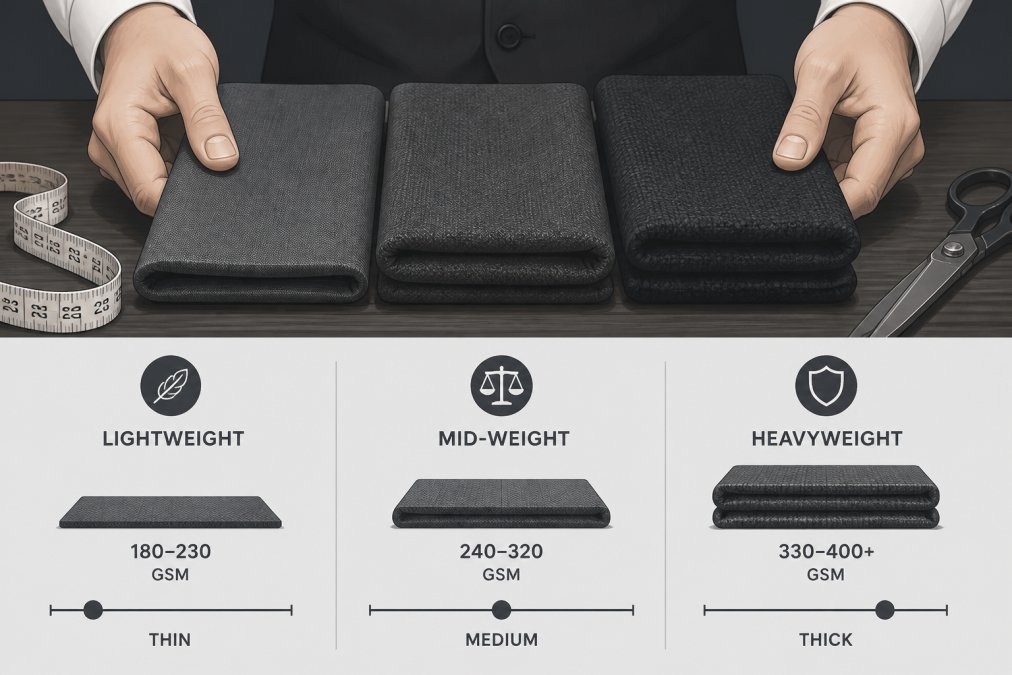
Lightweight fabric sits under 260 GSM. It drapes softly, breathes well and packs small. It also creases faster and shows wear sooner at the elbows and seat.
Mid-weight fabric runs 260 to 300 GSM. This is the sweet spot for most wardrobes: enough body to hold a crease, enough breathability to survive a warm afternoon.
Heavyweight fabric starts around 300 GSM. It hangs beautifully, resists wrinkles and looks formal. It also traps heat, which is a problem in a crowded room.
The Best All-Season Suit Fabric: Why Wool Wins
Wool is the best all-season suiting fabric because it regulates temperature rather than simply insulating. The fibre absorbs and releases moisture vapour, so it keeps you comfortable across a wider temperature range than cotton or synthetics.
That's not marketing. It's fibre physics, and it's why technical notes on wool's moisture management describe the same behaviour.
Linen creases within minutes. Cotton lacks the spring-back that keeps a suit looking crisp. Polyester blends hold shape but trap heat. Wool does the most jobs at once.
If you're shopping for a single versatile suit, a mid-weight wool in the 260 to 300 GSM band is our pick every time.
Four-Season Wool, Fresco and Tropical Wool Compared
Not all year-round wool is the same. The weave matters as much as the weight.
- Four-season wool: a plain or twill weave in the mid-weight band. The default choice for most buyers.
- Fresco: an open, high-twist weave. Breathable despite its weight, with a dry hand and excellent crease recovery. Ideal for humid summers.
- Tropical wool: a lightweight, porous cloth under 240 GSM. Superb in heat, less durable over years of hard wear.
Fresco is the insider's answer for anyone who runs warm but still wants structure. It's the cloth most guides skip.
Lightweight Suit Fabrics for Summer and Warmer Days
For genuinely hot days, drop into the 220 to 250 GSM range and choose an open weave. Tropical wool, Fresco and lightweight hopsack all work. Linen and linen-wool blends breathe superbly but crease on purpose, which suits a relaxed event and not a formal one.
A common mistake is buying the lightest cloth available. Below about 200 GSM, a suit loses structure and starts to look like a shirt with trousers attached. If you want to see a lighter suit you can actually buy, browse this slim fit burgundy suit.
How Breathability, Warmth and Drape Change With Weight
Breathability falls as weight rises, but not in a straight line. Weave openness matters just as much. A 280 GSM Fresco breathes better than a tightly woven 240 GSM twill.
Warmth rises with weight and density. Drape, the way cloth falls and holds its line, improves as weight increases, which is why heavier suits photograph so well.
Temperature regulation is the balance point. Mid-weight wool with an open weave keeps you cool in a warm room and warm in a cool one. Readers worried about staying cool can explore summer waistcoat alternatives for men.
Construction and Lining: The Factors That Sit Alongside Cloth Weight
Cloth weight gets all the attention, but construction decides how the suit actually feels. A half-canvassed jacket with a breathable lining will outperform a heavier fused jacket in warm conditions, and a fully lined heavy suit becomes unbearable indoors, no matter how good the cloth is.
Lining: The Hidden Variable
The lining is the layer between you and the cloth, and it changes the effective warmth of a suit more than most buyers expect. Three options matter:
- Fully lined: the default for most suits. It adds structure and warmth, which is fine for cool climates and air-conditioned offices but can feel stifling in humid heat.
- Half or quarter lined: the lining covers only the upper back and shoulders, leaving the lower back open to the cloth. This is the practical choice for a year-round suit in a warm or variable climate because it lets heat escape without sacrificing shoulder structure.
- Unlined: rare in structured suits and best left to casual, unstructured jackets. It breathes best but offers the least shape.
Lining fibre matters too. Cupro and bemberg breathe and feel cool against the skin; polyester linings trap heat and can feel clammy. If you are buying one suit for all-year wear, a half-lined jacket in cupro or bemberg is the safer bet than a fully lined polyester jacket, even if the cloth weight is identical.
Canvassing and Structure
A canvassed jacket has a floating layer of horsehair or wool canvas between the outer cloth and the lining, which gives shape and lets the jacket mould to you over time. A fused jacket glues the interlining to the cloth, which is cheaper and stiffer. For year-round wear, half-canvassed construction is the usual compromise: enough structure in the chest and lapels to look formal, without the weight and heat of a fully canvassed coat.
How to Judge a Suit in the Shop
- Pinch the cloth: if it feels dense and stiff at the same GSM as a softer cloth, it will wear warmer.
- Check the lining label: cupro or bemberg over polyester for warm conditions.
- Look for a half lining: open the jacket and see whether the lower back is lined or open.
- Ask about canvassing: a half-canvassed jacket is the practical year-round default.
Fit matters too. Once you've settled the cloth and construction, the next question is how the pieces pair together. For guidance on pairing a vest with a tie, see what tie to wear with a vest without jacket.
Durability, Maintenance and Cost-Per-Wear Trade-Offs
Lightweight cloth wears out faster. That's the honest trade-off.
Cost-per-wear is the number that matters, not the sticker price. To extend a suit's versatility, see the best dress shoes to wear with a navy suit.
Care habits extend any cloth: brush after wear, rest the suit a day between outings, hang it on a broad wooden hanger, and dry-clean sparingly.
Picking a suit that works all year comes down to one decision: stay in the mid-weight band unless your climate or calendar gives you a clear reason to leave it.
Frequently Asked Questions
What fabric weight is best for a year-round suit?
A mid-weight cloth of roughly 260 to 300 GSM (about 8 to 9 oz) suits most year-round wear. It holds a crease, drapes cleanly and stays comfortable through spring and autumn, with enough breathability for warmer indoor rooms. If you run warm or attend summer events, lean toward 240 to 260 GSM. If you wear the suit mostly in cooler months, 300 to 320 GSM gives more warmth without becoming a winter-only suit.
Is 280 GSM suit fabric suitable for year-round wear?
Yes. At 280 GSM you are squarely in the mid-weight band, which is the most versatile range for a single suit. It offers good structure and wrinkle resistance while remaining breathable enough for heated offices and mild days. Pair it with a half lining or unlined jacket if you tend to overheat, and it will handle most conditions comfortably.
What is the difference between GSM and ounces in suit fabric?
Both measure fabric weight. GSM means grams per square metre, used across most of the world. Ounces refers to ounces per square yard, still common in some British and American cloth houses. The rough conversion is 1 oz per square yard equals about 34 GSM, so 10 oz is roughly 340 GSM. Always check which unit a retailer uses before comparing cloths.
Which suit fabrics work best across different seasons?
Wool is the most versatile fibre. Four-season wool in a mid-weight plain or twill weave covers most of the year. For summer, look at lightweight wool, tropical wool, Fresco, linen and cotton blends. For winter, heavier wool, flannel and wool blends add warmth. Weave matters as much as weight: open weaves breathe better, tighter weaves resist wind and hold their shape.
