
Should You Wear a Belt With a Suit? A Buyer's Guide

Last Updated: October 24, 2026
Quick Summary
Choose a formal belt that matches your shoes rather than your suit, keeps the width between 30mm and 35mm, and uses a simple buckle in a finish that matches your other metal. Buy full-grain leather if your budget allows, and skip the belt only with side adjusters or braces.
- Match the belt to your shoes, not your suit, staying within one or two shades.
- Suit belts should measure between 30mm and 35mm wide to pass through belt loops.
- Buy your belt one size up from your trouser waist size so the buckle sits on the middle hole.
- Condition the leather two to three times a year with a neutral leather cream.
- If you own one belt, make it a 32mm dark brown full-grain leather belt with a brushed silver rectangular buckle.
Table of Contents
- Should You Wear a Belt With a Suit?
- How to Match a Belt With a Suit
- Belt Colour for a Navy Suit (and Other Suit Shades)
- Belt Width for Suits: The Measurement That Decides the Look
- Leather Quality and Construction Checks
- Buckle Styles for Formal Dress Codes
- Getting the Size and Fit Right
- Caring for Your Formal Belt So It Lasts
- Frequently Asked Questions
Should You Wear a Belt With a Suit?
Yes, in most cases you should wear a formal belt with a suit, and getting it right comes down to four choices: colour, width, leather quality and buckle style. This guide from SimonVon Shop walks through each one, plus the situations where skipping the belt is the smarter move.
The belt is the most overlooked piece in a suit outfit. Most men spend hours on the jacket and minutes on the belt. That order is backwards.
Here is the short version before we go deeper:
- Match the belt to your shoes, not your suit.
- Keep the width between 30mm and 35mm for suit trousers.
- Choose a simple buckle in a finish that matches your other metal.
Below, we break down each decision, including when to skip the belt entirely.
When to Skip the Belt Entirely
Side adjusters and braces remove the need for a belt. If your trousers have side tabs or you wear suspenders, skip the belt and let the waistband sit clean.
Waistcoats change the maths too. If you want guidance on pairing the two, our guide on how to choose a waistcoat for a three piece suit covers the layering rules.
One caveat: never skip the belt if your trousers have loose belt loops and no side adjusters.
How to Match a Belt With a Suit
Matching a formal belt to a suit means coordinating three things: colour to your shoes, width to your trousers, and hardware to your watch or cufflinks. Get those three aligned and the belt disappears into the outfit, which is exactly what it should do.
The colour rule is the one people break most often. Match the belt to your shoes, not to your suit. A navy suit with brown shoes takes a brown belt.
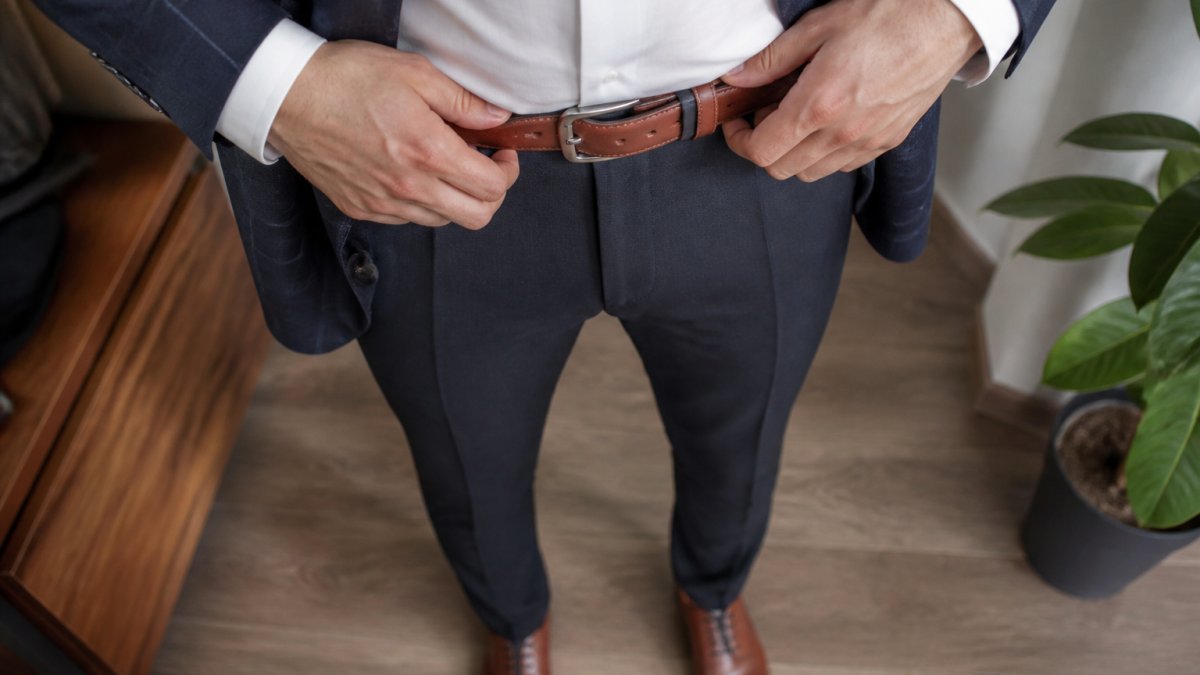
Matching Belt Colour to Shoe Colour
Stick within one or two shades of your shoes. Dark brown belt with dark brown shoes. Tan with tan. Black with black. A tan belt against black shoes splits the outfit in half and draws the eye straight to your waist.
For black suits specifically, our guide to accessorizing a black suit shows how the same colour rules shift when the suit itself is the darkest element in the outfit.
Belt Colour for a Navy Suit (and Other Suit Shades)
For a navy suit, a mid-brown or dark brown formal belt is the safest choice, paired with brown shoes. Black works too, but only with black shoes. Navy is the most forgiving suit colour, which is why it dominates wedding and school ball dressing.
But suit shade alone is not enough to choose a belt. The same navy suit needs a different belt for a job interview than for a summer wedding.
Step 1: Suit shade sets the leather tone
| Suit Shade | Best Belt Colour | Shoe Colour to Match | Notes |
|---|---|---|---|
| Navy | Mid or dark brown | Brown | Most versatile pairing |
| Charcoal | Black or dark brown | Black or dark brown | Keep belt and shoes identical |
| Black | Black | Black | Brown rarely works here |
| Light grey | Tan or mid brown | Tan or brown | Lighter leather lifts the outfit |
| Mid blue | Dark brown | Dark brown | Avoid black, it looks harsh |
The pattern is simple: lighter suits take lighter leather, darker suits take darker leather, and the belt always tracks the shoe.
Step 2: Formality sets the finish
A polished leather belt with a high shine reads more formal than a matte or grained leather belt in the same colour. For business and interviews, choose a polished calfskin in black or dark brown. For weddings and social events, a slightly softer finish in mid-brown or tan is appropriate. For black-tie-adjacent outfits, the belt should be as close to invisible as possible: black, polished, with a covered or very simple buckle.
Step 3: Occasion sets the buckle and hardware
A job interview calls for a brushed silver or gold rectangular buckle with no visible logo. A wedding allows a polished buckle and a slightly warmer leather tone. A black-tie event calls for a covered buckle or a very slim polished frame, and the metal should match your cufflinks and watch case. If you are unsure, err towards the quieter option: a plain buckle in the same finish as your other metal always looks deliberate, while a logo or oversized buckle looks like a mistake at a formal event.
For black suits specifically, our guide to accessorizing a black suit shows how the same colour rules shift when the suit itself is the darkest element in the outfit.
Belt Width for Suits: The Measurement That Decides the Look
Suit belts should measure between 30mm and 35mm wide. Anything narrower looks like a casual belt borrowed from jeans.
Why does width matter so much? Because it has to pass through the belt loops. Most suit trousers are cut with loops sized for a 32mm to 34mm belt.
- 30mm to 32mm: slim build, slim-cut suits, modern tailoring
- 33mm to 35mm: the safe middle ground for most suits
- 36mm and above: casual territory, not for dress trousers
If you are between sizes, go with 32mm. It reads as formal without looking thin.
Leather Quality and Construction Checks
Full-grain leather is the top grade for a formal belt, and it is the easiest quality signal to check before you buy. Full-grain keeps the outer surface of the hide intact, so it ages into a patina rather than cracking.
Here is what to look for when you buy online:
- Edge finish: stitched or burnished edges hold up; raw painted edges peel
- Stitching: tight, even stitches with no loose threads at the buckle end
- Buckle attachment: a stitched or riveted fold, not a single flimsy stitch
A common mistake is buying on looks alone. A belt that photographs beautifully but has a glued edge will start separating within months of regular wear.
Buckle Styles for Formal Dress Codes
A simple rectangular frame buckle in brushed or polished metal is the correct choice for formal dress codes. Save the oversized buckles, logos and textured plates for casual wear. At a wedding or black-tie event, the buckle should be the quietest metal in the outfit.
But "simple rectangular" covers a wide range. The right buckle depends on the dress code, and the differences are small but visible. Use this breakdown.
Buckle size and shape by dress code
| Dress Code | Buckle Width | Shape | Finish | Logo |
|---|---|---|---|---|
| Business / interview | 30-35mm | Rectangular frame | Brushed or polished silver/gold | None visible |
| Wedding (guest or groom) | 30-35mm | Rectangular or slightly rounded frame | Polished silver/gold | None or very subtle |
| Black-tie-adjacent | 25-30mm | Slim rectangular or covered | Polished, matching cufflinks | None |
| Smart-casual | 35-40mm | Any simple frame | Any | Small logo acceptable |
A buckle wider than the belt strap looks unbalanced. A buckle narrower than the strap looks cheap. The frame should be roughly the same width as the leather, or slightly narrower for very formal outfits.
Metal finish and matching hardware
Match the buckle finish to your other hardware. Silver buckle with a silver watch and silver cufflinks. Gold with gold. Mixed metals can work, but it takes confidence and a very deliberate outfit.
Brushed metal is more forgiving and reads as more modern. Polished metal is more traditional and photographs better under event lighting. If you wear a suit daily, a brushed finish hides scratches better.
Covered buckles and when to use them
For very formal events, a covered buckle, where the frame is wrapped in the same leather as the strap, is the most traditional option. It reads as considered rather than showy. Covered buckles are common on dress belts sold with morning suits and tuxedos, and they are the safest choice when the dress code is unclear but the event is clearly formal.
Buckle attachment and quality checks
The buckle should be attached with a stitched or riveted fold, not a single flimsy stitch. Give the buckle a gentle tug before you buy: if the leather stretches or the stitching looks strained, the belt will fail at the buckle end first. A solid brass or stainless steel buckle will outlast a plated zinc one, which can flake or discolour with wear.
Getting the Size and Fit Right
Buy your belt one size up from your trouser waist size. If you wear 86cm trousers, order a belt sized for roughly 91cm.
Fit checks before you commit:
- The tip should reach the first belt loop past the buckle, no further
- The buckle sits centred on the waistband
- You can fit one finger between the belt and your body
If you are ordering a suit and belt together, our men's suit size guide for online ordering explains how to measure your waist so the belt sits at the right height.
Watch out: ordering your exact trouser size is the most common sizing error. It leaves you on the last hole with no adjustment, and the tip hangs past the first loop.
Caring for Your Formal Belt So It Lasts
Leather belts last years with basic care, and most fail early because of neglect rather than wear.
Condition the leather two to three times a year with a neutral leather cream. Avoid silicone-based polishes, which dry the hide out. Keep belts away from direct sun and radiators, and rotate between two belts if you wear a suit daily.
If you look after leather accessories properly, they outlast everything else in the outfit. Our guide on how to clean and maintain formal cufflinks follows the same principle: small habits, long life.
If you want the complete picture of what sits alongside the belt, our formal wear accessories checklist covers the rest of the outfit.
The belt is a small purchase that decides whether a suit looks sharp or slightly off, and most men get the width or colour wrong without realising it.
Get started with SimonVon Shop and build a formal outfit that holds together from the buckle to the cufflinks.
Frequently Asked Questions
Should you wear a belt with a suit that has side adjusters?
You can, but you do not need to. Side adjusters are built into the trouser waistband to hold it up without a belt, so adding one is purely a style choice. If the waistband has no belt loops, wearing a formal belt is not an option anyway. When loops are present and you want a cleaner line, skip the belt or wear braces instead.
What colour belt should you wear with a navy suit?
Brown is the safest choice for a navy suit, in shades from dark chocolate to mid-brown depending on the formality of the occasion. Black works for evening events and very formal settings. Match the belt to your shoes as closely as you can, and keep the buckle finish consistent with your watch or cufflinks so the hardware reads as one deliberate choice.
How wide should a formal belt be for a suit?
Aim for a width that suits dress trousers and suits. Anything narrower reads as casual, and anything wider starts to look like a jeans belt. The belt should also sit comfortably inside the trouser loops without bunching the fabric. If you are between sizes on width, consider the narrower option for black tie and the wider end for business wear.
Is it better to wear braces or a belt with a suit?
Braces keep the trouser line uninterrupted and are the traditional choice with high-waisted formal trousers, while a belt is simpler and more versatile across outfits. For black tie and very formal dress codes, braces often look sharper. For weddings, school balls and office wear, a well-fitted formal belt in matching leather is the practical default.
