
How to Measure Suit Size Accurately

Table of Contents
- What You'll Need to Measure Your Suit Size
- How to Measure Chest for Suit Jacket
- Measuring the Waist and Shoulder Width
- Measuring Sleeve Length and Trouser Inseam
- How a Suit Should Fit Guide
- Menswear Big and Tall Options
- Tips for Accurate Measuring and Common Mistakes to Avoid
Last Updated: August 23, 2026
What You'll Need to Measure Your Suit Size
Gather a soft measuring tape (flexible, not rigid metal), a mirror, and ideally a second person to help. A pen and paper for recording measurements is useful. Wear the dress shirt you plan to wear under your suit, as fabric thickness affects how the tape should sit. Ensure your measuring tape is in good condition and test it first if borrowed. The tape should be snug but not tight, too tight and your suit will feel restrictive; too loose and it will hang awkwardly.
How to Measure Chest for Suit Jacket
Stand in front of a mirror with your arms relaxed at your sides. Wrap the measuring tape around the fullest part of your torso at nipple level. The tape should sit horizontally and parallel to the ground, snug without digging in or leaving an indent.
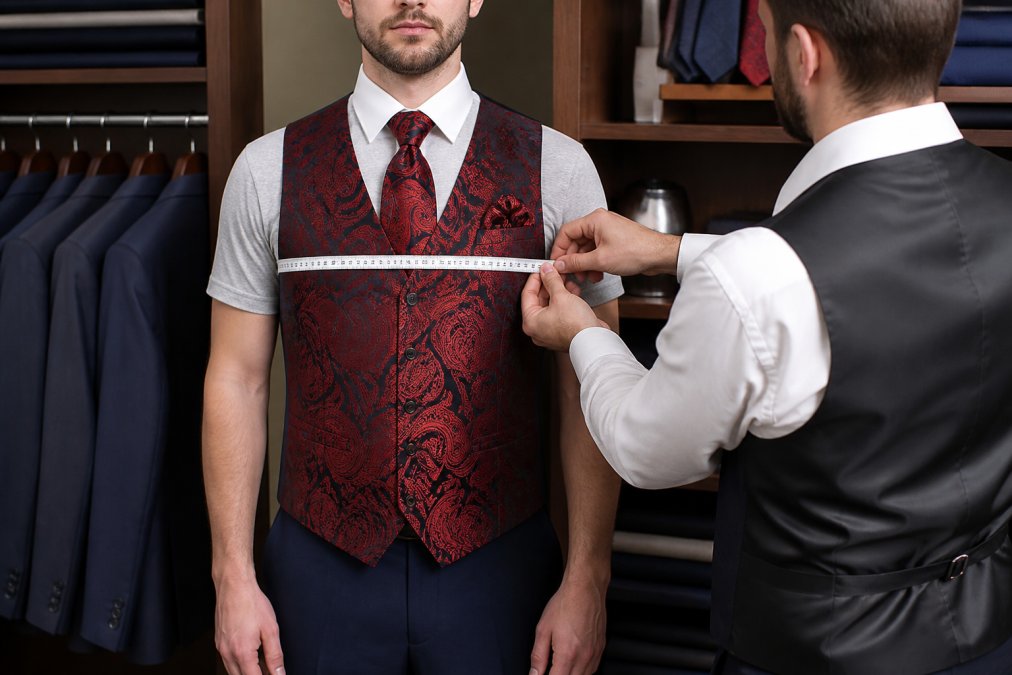
Take the measurement where the tape meets itself and write it down immediately. A 100 cm chest typically corresponds to a size 40 jacket, 105 cm to size 42, and 110 cm to size 44 (peer-reviewed research). However, always check the specific size chart for the suit you're interested in, as different brands cut differently.
If you're between sizes, consider your body type and fit preference. Some men prefer a closer, tailored silhouette, while others prefer a roomier cut for layering.
Measuring the Waist and Shoulder Width
Find your natural narrowest point, typically 2-3 cm above your navel, and wrap the tape around this area horizontally. Use gentle snug tension, not tight. Your waist measurement helps determine trouser fit and ensures the jacket drapes properly.
Shoulder width is best measured by a second person. Stand facing forward with arms relaxed while your helper measures from the top of one shoulder bone to the top of the other. This measurement affects how the jacket shoulders sit. If measuring alone, use a well-fitting jacket you already own and measure across the back from seam to seam at the shoulder. Most size 40 jackets have shoulders around 43-44 cm, size 42 around 45-46 cm, and size 44 around 47-48 cm (peer-reviewed research).
For formal occasions like weddings, accurate measurements for each person prevent ordering issues. SimonVon Shop stocks a range of sizes to accommodate different body types, from standard to big and tall options.
Measuring Sleeve Length and Trouser Inseam
Sleeve length is measured from the centre back of your neck, down your shoulder, and along your arm to your wrist bone. Have someone help if possible. Your helper should place the tape at the base of your neck, run it over your shoulder, and down the outside of your arm to the wrist bone.
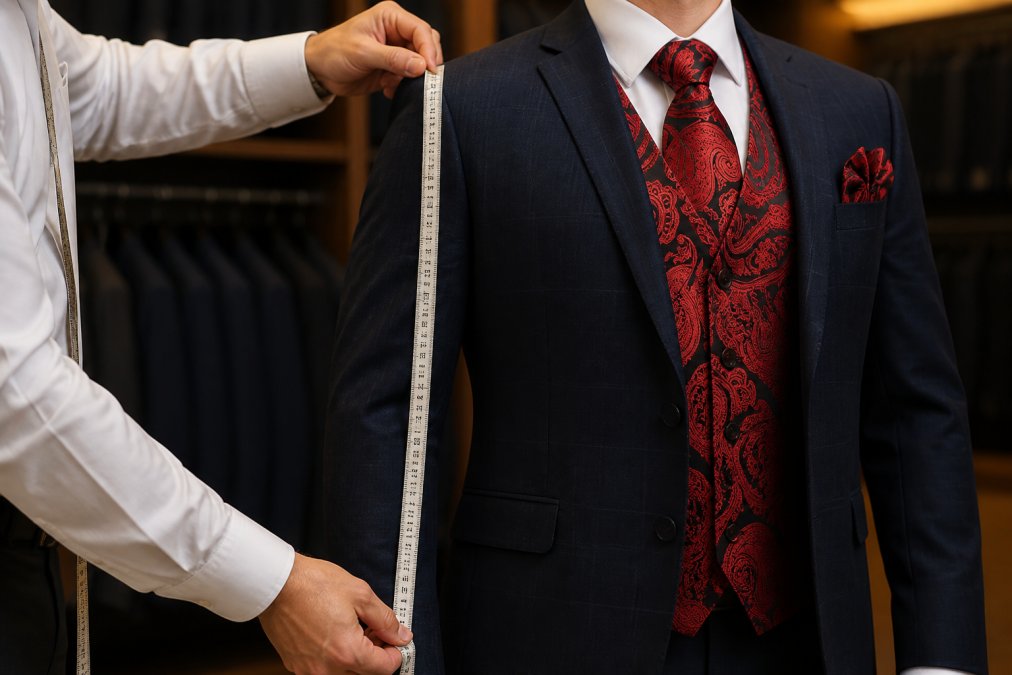
If measuring alone, measure from your wrist bone to your armpit and add roughly 20 cm. For suit jackets, most size 40 jackets have sleeves around 81-83 cm, size 42 around 84-86 cm, and size 44 around 87-89 cm (peer-reviewed research).
For trouser inseam, stand in front of a mirror wearing the dress shoes you'll wear with your suit. Measure from your natural waist down the inside of your leg to where the trouser should break at your shoe, typically 1-2 cm above the top. A slight break (where the trouser just touches the top of your shoe) is classic and works for most formal occasions.
How a Suit Should Fit Guide
A well-fitting suit jacket should have shoulders that align with your natural shoulder points. The jacket length should reach to about mid-hand when your arms hang naturally, roughly 2-3 cm below your wrist.
The jacket should be snug enough to button comfortably without pulling, but loose enough to fit a flat hand inside when buttoned. Sleeve length should show about 1-2 cm of shirt cuff when your arms hang down. Trousers should sit at your natural waist with a slight break at the shoe, draping smoothly without pulling or bunching.
Menswear Big and Tall Options
Big and tall menswear options exist because proportions change at different sizes. A size 50 jacket isn't just a size 40 scaled up, the sleeve length, shoulder width, and torso proportions are all adjusted.
Chest sizes in big and tall ranges typically start at 110 cm and go up to 130 cm or beyond. Sleeve lengths are proportionally longer; a size 50 jacket will have sleeves around 90-92 cm. Trouser inseams for taller men start higher, with options up to 95 cm or more for men over 190 cm tall.
Shoulder width in big and tall jackets is also wider. A size 50 might have shoulders around 50-51 cm, compared to 47-48 cm for a size 44. SimonVon Shop stocks big and tall options specifically for this reason, ensuring everyone looks sharp regardless of frame size.
When measuring for big and tall suits, the process is identical: chest, waist, shoulder-to-shoulder, sleeve length, and inseam. Always use the big and tall size chart specific to the brand you're ordering from.
Tips for Accurate Measuring and Common Mistakes to Avoid
The most frequent measuring error is pulling the tape too tight, which gives a smaller measurement and results in ordering a suit that's too snug. The tape should feel snug like a gentle hug, not restrictive.
Always measure over only the dress shirt you'll wear under the suit, not thick clothing. Stand naturally with shoulders relaxed, not puffed out or hunched. Keep your arm in a natural relaxed position when measuring sleeve length.
Bodies change over time. If you haven't measured in a year or two, take fresh measurements before ordering. When you have your measurements, compare them against the specific size chart for the suit you want. Don't assume a size 42 from one brand fits the same as another.
If you're between sizes, consider what you're using the suit for. For a one-off formal event, choose the size that gives you the most comfortable fit right now. For a suit you'll wear regularly, consider whether you want room to move and layer.
Record your measurements and keep them accessible on your phone. This lets you instantly verify if a suit will fit when shopping online.
Getting your suit measurements right is the foundation of looking sharp for any formal occasion. Whether you're ordering for a wedding, a school ball, or professional events, these measurements, chest, waist, shoulders, sleeves, and inseam, determine whether your suit will fit properly.
SimonVon Shop provides detailed size charts for every suit and formal wear item, so once you have your measurements, you can confidently select the right size. With a range that includes big and tall options and complete styling solutions including waistcoats and formal accessories like the Luxury Dark Red Black Paisley Silk Men's Vest Hanky Cufflinks Tie Set, you'll find pieces that fit properly and work together as a coordinated outfit. Start with accurate measurements, check the size chart, and you're set for a suit that looks tailored to you.

Frequently Asked Questions
How do I measure suit size if I'm a bigger bloke or have size variation in my wedding party?
Measure each person individually using the chest circumference method, this is your primary sizing reference. For bigger frames, measure the fullest part of the torso, not just across the shoulder blades. SimonVon Shop stocks extended sizes to accommodate all body types. Always check the sizing chart before purchasing, as it differs from standard sizing. If you have groomsmen of varying sizes, measuring each one ensures everyone gets a proper fit rather than guessing from a single size.
What's the difference between my chest measurement and my suit jacket size?
Your chest circumference measurement is typically 5-10 cm larger than your suit jacket size. For example, a 102 cm chest measurement usually corresponds to a size 38 jacket. This extra room allows for layering and comfortable movement. The suit jacket size also accounts for your shoulder width and torso length. Always cross-reference your measurements against the brand's size chart rather than assuming a direct match.
How should a suit jacket fit across the shoulders?
The shoulder seam should sit right at your shoulder bone, creating a clean line from your neck down your arm. There should be no bunching or excess fabric, and your shoulder blades should sit comfortably without pulling. The jacket should allow full arm movement without the fabric riding up when you raise your arms. If the shoulders are too tight or too loose, the jacket won't hang properly regardless of other measurements.
Do I need a tailor to measure my suit size, or can I do it myself?
You can measure yourself accurately at home with a measuring tape and a friend to help, particularly for back measurements. The key is keeping the tape snug but not tight, and maintaining a natural stance. For the most precise fit before ordering online, ask a friend to take measurements while you stand relaxed with arms at your sides. If you're uncertain after measuring, many retailers, including SimonVon Shop, offer guidance on sizing charts to help you choose the right size before purchase.
This article was written using GrandRanker