
How to Style Pocket Squares: 2026 Folding Guide

Table of Contents
- Why a Pocket Square Finishes the Look
- Pocket Square Folding Techniques: Four Folds Worth Knowing
- How to Match Pocket Square with Tie and Shirt
- Choosing Fabric and Size for Your Jacket
- Formal vs Casual: When to Wear Which Fold
- Best Mens Formal Accessories NZ: Building a Coordinated Set
- Pocket Square Care and Common Mistakes
- Frequently Asked Questions
Last Updated: September 10, 2026
Why a Pocket Square Finishes the Look
A pocket square is the fastest way to lift a suit from ordinary to deliberate. The jacket and shirt do the heavy lifting; the square is what tells people you thought about it.
This guide from SimonVon Shop covers how to style pocket squares for weddings, school balls, and boardrooms, from the four folds worth learning to the fabric and sizing decisions that separate sharp style pocket squares from a fussy one. Most men treat the square as an afterthought, grabbed five minutes before leaving. That is exactly why it stands out when it is done properly. The good news: you do not need a drawer full of options. You need one square that suits the jacket, two folds you can execute in under a minute, and a basic grasp of colour. Below, we break down the folds, the matching rules, and the mistakes that flatten an otherwise strong outfit.
Pocket Square Folding Techniques: Four Folds Worth Knowing
Four folds cover almost every occasion: the presidential, the puff, the three-point peak, and the flat fold. Learn these and you can dress a square for a job interview or a black-tie gala without thinking about it.
A common mistake is folding too precisely. A square that looks ironed flat reads as stiff; a little asymmetry signals ease. Work on a flat surface, not in your hand.
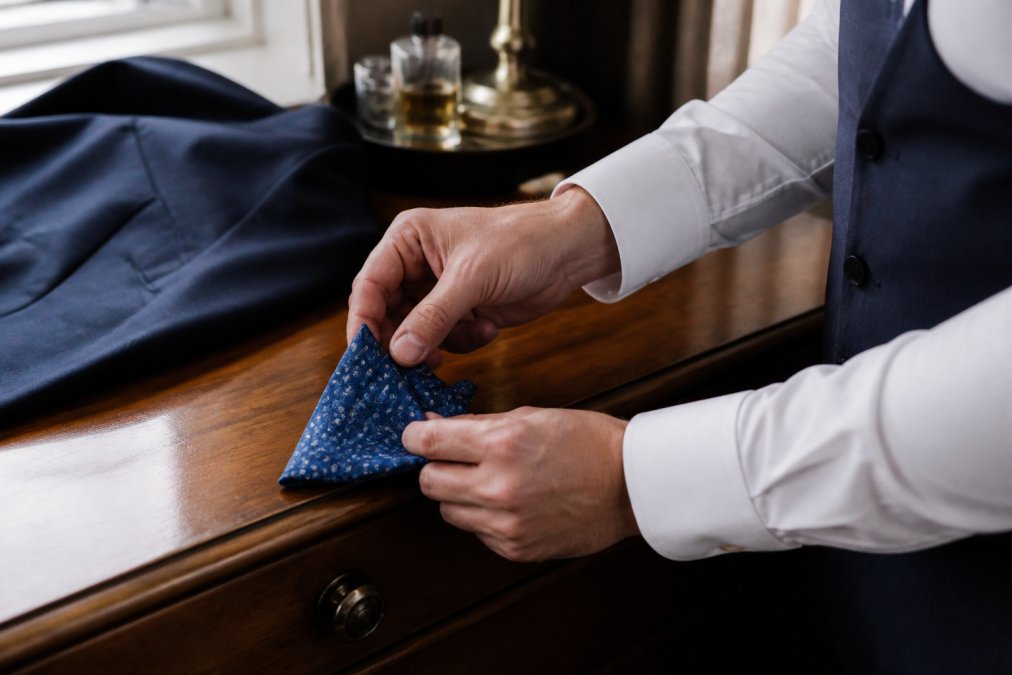
The Presidential Fold
The presidential fold is the most formal option: fold the square into a neat rectangle so a straight band of fabric sits above the pocket. It suits business meetings, funerals, and any setting where understatement matters. Keep the visible edge narrow, roughly 1 cm, and make sure it sits level. Pair it with a solid white or cream square and let the suit do the talking.
The Puff Fold
The puff fold is the most forgiving and the easiest to learn. Pinch the centre of the square, lift it, and let the edges fall naturally, then tuck the base into the pocket so only a soft, rounded shape shows. It works with almost any fabric and hides a less-than-perfect press. For casual jackets and business casual settings, this is the fold to default to.
The Three-Point Peak
The three-point peak creates a structured triangle effect and reads as the most decorative of the four. Fold the square into a triangle, then offset two more points to create three peaks, and tuck the base in. It pairs well with formalwear and photographs sharply. Silk holds the peaks best; linen tends to slump, so save linen for the puff instead.
How to Match Pocket Square with Tie and Shirt
The safest rule when you match a pocket square with a tie is this: coordinate, do not duplicate. A square that exactly copies the tie looks like a boxed set. Pick up one colour from the tie's pattern and let the square echo it against a different background.
That rule is easy to state and hard to apply, because it does not explain why some echoes work and others look accidental. The mechanism is colour theory, and once you understand it you stop guessing.
The colour theory behind a coordinated look
Every colour has three properties: hue (the colour itself), value (how light or dark it is), and saturation (how vivid or muted it is). A pocket square reads as intentional when it shares at least one property with the tie and differs on at least one other. Share all three and you get the boxed-set effect; share none and the square looks like it wandered in from another outfit.
- Analogous harmony. Colours next to each other on the colour wheel, navy and teal, burgundy and rust, olive and mustard, sit together calmly. This is the safest way to echo a tie without matching it.
- Complementary contrast. Colours opposite each other, navy and amber, burgundy and forest green, create deliberate tension. Use this when the tie is solid and you want the square to add energy.
- Value contrast. A light square against a dark tie (or the reverse) separates the two visually even when the hues are close. This is why a cream square works with almost any dark tie.
- Saturation matching. A muted tie wants a muted square. Pairing a dusty linen square with a glossy silk tie creates a fight the eye notices before it notices the outfit.
A useful test: squint at the tie and square together. If they blur into one shape, they are too close. If they read as two distinct blocks that clearly belong to the same palette, you have it right.
Pattern pairing by scale
Pattern is where most men overthink it. The working principle is scale, not type:
- Patterned tie, solid square. The default. Let the tie carry the pattern and the square provide a clean counterweight.
- Solid tie, patterned square. The square becomes the focal point. Keep the pattern small and the palette drawn from the tie.
- Patterned tie, patterned square. Possible, but the two patterns must differ in scale, a fine stripe tie with a large floral square, for example. Two patterns of similar scale compete and neither wins.
Shirt as the anchor
A white shirt is a neutral canvas: almost any square works, which is why it is the safe choice for a first formal outfit. A coloured or striped shirt is busier, so keep the square quiet and let the shirt lead. If the shirt has a stripe, echo the stripe colour in the square rather than introducing a new hue.
The same logic applies to a bow tie. A coordinated bow tie and square set removes the guesswork entirely, which is why matched sets are the practical route for anyone who does not want to reason through colour theory before every event.

Choosing Fabric and Size for Your Jacket
Fabric and size matter more than most guides admit. Silk is the classic choice: it holds a fold, catches light, and suits formalwear. Linen has texture and a relaxed character that works for daytime events, though it creases. Cotton sits in the middle, durable and easy to care for. Wool squares add warmth and weight for cooler months.
How square size interacts with your jacket
A standard 23 x 23 cm square fits most breast pockets, but the visible result depends on two jacket measurements most guides ignore: pocket depth and lapel width.
- Pocket depth. A slim-cut jacket often has a shallow breast pocket. A bulky fold in a shallow pocket sits too high and towers over the edge. A flat or presidential fold, which adds almost no bulk, is the right call here. A deeper pocket on a traditional jacket can take a puff or a three-point peak without spilling.
- Lapel width. A wide lapel (roughly 9 cm or more) balances a fuller puff or a taller peak. A narrow lapel (roughly 6 cm or less) is overwhelmed by a large fold, keep the visible portion small and the shape restrained. The square should sit in proportion to the lapel, not fight it.
- Visible portion. Regardless of fold, keep the square roughly 1 to 2 cm above the pocket edge. More than that and it reads as a flag rather than a detail.
If your square is slightly too large for a shallow pocket, fold it so the bulk sits below the pocket line rather than trimming it. Trimming frays the edge and ruins the hand-rolled finish on a good silk square.
Troubleshooting the problems nobody warns you about
- The square slips down into the pocket. Silk is smooth and gravity wins over a long evening. Fold with a little more bulk at the base, or tuck the base under the pocket's inner lip so it grips. A square with a stitched or rolled edge holds better than a raw-cut one.
- The fold loses its shape. Linen slumps; silk holds. If you need a peak to survive a long event, choose silk. For a puff, a light press before folding helps the fabric remember the shape.
- The square looks too tall or too flat. This is almost always a visible-portion problem, not a fold problem. Adjust how much sits above the edge before you change the fold.
- The square clashes with the jacket texture. A glossy silk square against a matte tweed jacket can look mismatched. A linen or wool square in a similar texture family sits more naturally with casual jackets.
Fabric sourcing and care
If you care where your silk comes from, look for hand-rolled edges and a stated fibre content, hand-rolled edges signal a square made to last rather than a mass-produced one. Care is simple: hand wash silk in cool water or dry clean it, and press linen while slightly damp. Store squares flat or loosely rolled, never crumpled in a drawer, or the folds set in the wrong places.
| Fold | Formality | Best Fabric | Best For |
|---|---|---|---|
| Presidential | High | Silk, cotton | Business, funerals |
| Puff | Low to mid | Linen, cotton | Casual, business casual |
| Three-point peak | High | Silk | Formalwear, galas |
| Flat | Mid | Cotton, linen | Everyday tailoring |
Formal vs Casual: When to Wear Which Fold
Match the fold to the occasion, not your mood. Formal settings, including black-tie events and weddings, call for the presidential or three-point peak in silk. Business settings sit in the middle: a flat fold or a restrained puff keeps things professional without looking stiff.
For business casual and weekends, the puff fold in linen or cotton is the natural pick. It softens a blazer without dressing it up. A tuxedo demands a crisp white silk square in a presidential fold; a tweed jacket in winter welcomes a wool puff. The square should feel like it belongs to the outfit, not bolted on.
Best Mens Formal Accessories NZ: Building a Coordinated Set
The best mens formal accessories NZ shoppers can buy are the ones that work together as a set rather than as isolated pieces. A pocket square, bow tie, and cufflinks in a shared colour story do more for an outfit than three expensive items that clash.
This is where a matched set saves time and money. SimonVon Shop stocks silk bow tie, pocket square, and cufflinks sets at $34.50, including the black and golden floral set and the black and silver floral set, both finished with hand-rolled edges. For a white-shirt formal look, the pure white paisley set is a clean choice that works with almost any jacket. Each set includes a pre-tied bow tie, a 23 x 23 cm pocket square, and two cufflinks, which covers the full accessory brief in one purchase.

Pocket Square Care and Common Mistakes
Care is simple: hand wash silk in cool water or dry clean it, and press linen while slightly damp. Store squares flat or loosely rolled, never crumpled in a drawer, or the folds set in the wrong places.
The most common mistakes are easy to fix. Stuffing the square too high so it towers over the pocket looks amateur; keep the visible portion to roughly 1 to 2 cm above the edge. Matching the square exactly to the tie flattens the look. Choosing a square that is too bulky for a slim jacket ruins the line. And ignoring the occasion, wearing a bright patterned puff to a funeral, undoes everything else you got right.
Frequently Asked Questions
What is the rule for pocket squares?
The main rule is that your pocket square should complement your tie, not match it exactly. Choose a colour that picks up a secondary shade from your tie or shirt pattern. For formal events, white linen in a presidential fold is always safe. The fabric should sit naturally in the breast pocket with about 2-4 cm of fold visible above the pocket line.
What are common pocket square mistakes?
The most frequent errors are matching the pocket square exactly to the tie, using a fold that looks too stiff or symmetrical for a casual outfit, and choosing a square that is too large for the jacket's pocket depth. Another mistake is ignoring fabric weight: a heavy wool square will not hold a puff fold well. Keep the fold proportionate to the occasion and the jacket style.
Should a pocket square match your tie?
No, it should coordinate rather than match. Exact matching looks dated and flat. Instead, pull one colour from your tie's pattern and let the pocket square echo it, or choose a complementary colour from the colour wheel. If your tie is patterned, keep the square solid or subtly textured. If the tie is solid, a patterned square adds visual interest without clashing.
How do you fold a pocket square for a wedding?
For a wedding, the presidential fold or a soft puff fold works best. The presidential fold gives a clean horizontal line that photographs well and suits formal suits. A puff fold adds a relaxed elegance for outdoor or daytime ceremonies. Match the square to the wedding party's colour palette, and avoid overly bright patterns that distract in photos.
A well-styled pocket square is the difference between wearing a suit and commanding a room. SimonVon Shop makes that easy with coordinated silk sets that include the bow tie, pocket square, and cufflinks, all at $34.50, alongside waistcoats and dress shirts for weddings, school balls, and formal events. Get started with SimonVon Shop and finish every outfit with a square that looks deliberate.