
Necktie and Pocket Square Combinations: A How-To Guide

Table of Contents
- The Golden Rule of Matching Neckties and Pocket Squares
- Coordinating Colours and Tones for Your Ensemble
- How to Fold a Pocket Square for Formal Occasions
- Matching Tie and Pocket Square Rules for Different Patterns
- Wedding Suit Accessory Combinations and Styling
- Common Mistakes to Avoid When Pairing Ties and Pocket Squares
- Building Your Formal Accessory Wardrobe
- Frequently Asked Questions
Last Updated: September 28, 2026
The Golden Rule of Matching Neckties and Pocket Squares
The golden rule of necktie pocket square combinations is straightforward: they should complement each other without being identical. Think of them as partners, not twins. Your necktie and pocket square combinations work best when they share a colour family but differ in pattern or tone.

The tie typically carries more visual weight, so your pocket square should either echo its colour in a subtler way or introduce a complementary accent. At SimonVon Shop, we offer coordinated sets that make this easier.
The most common mistake is treating them as an afterthought. Many men grab whatever pocket square is clean without considering how it interacts with their tie. Instead, spend 30 seconds thinking about the relationship between the two pieces before you leave the house.
Coordinating Colours and Tones for Your Ensemble
Colour coordination is where most men struggle with necktie and pocket square combinations. Warm tones include reds, oranges, golds, and warm browns; cool tones are blues, purples, silvers, and cool greys. If your tie leans warm, your pocket square should either match that warmth or introduce a neutral that bridges both. Never pair a warm tie with a distinctly cool pocket square unless you're deliberately creating contrast for a bold statement.
Complementary vs. Matching Sets
Complementary colours sit opposite each other on the colour wheel. A burgundy tie pairs beautifully with a cream or soft gold pocket square. A navy tie works with a warm tan or champagne accent.
Matching sets feature the same colour family but different patterns. A floral silk tie in red pairs with a solid red pocket square.
Colour Theory for Different Skin Tones
Your skin tone matters more than most guides acknowledge. Men with warm undertones should gravitate toward golds, warm reds, oranges, and warm earth tones. Cool undertones suit silvers, blues, purples, and cool greys. To determine your undertone, hold a gold bracelet and a silver bracelet against your wrist; whichever looks more natural is your undertone.
How to Fold a Pocket Square for Formal Occasions
The way you fold your pocket square signals how formal the occasion is and how much attention you've paid to your appearance. There are several standard folds, each with its own formality level and visual impact.

The Presidential Fold
The presidential fold is the most formal option. Lay your pocket square flat, fold it in half horizontally, then vertically. Fold the top edge down about an inch, then fold that folded edge down again. Adjust until you have a clean rectangle with sharp edges. The result is a minimal, elegant line of colour visible in your pocket.
The Puff Fold
The puff fold is less formal but more visually interesting. Lay your pocket square flat, pinch the centre and lift it up, then let the fabric fall naturally around your fingers. Gently push the gathered fabric into your pocket. The result is a soft mound of fabric with gentle folds.
Matching Tie and Pocket Square Rules for Different Patterns
Pattern mixing is where necktie pocket square combinations become genuinely interesting, but there are rules. Follow them and you'll look intentional.
Solid Colours with Geometric Prints
When pairing a solid-colour tie with a geometric print pocket square, ensure the pocket square's colours include at least one shade from your tie. A navy tie works beautifully with a pocket square featuring navy and white geometric patterns. The geometric print should be small to medium scale; large patterns compete with the tie rather than complement it.
Paisley and Floral Patterns
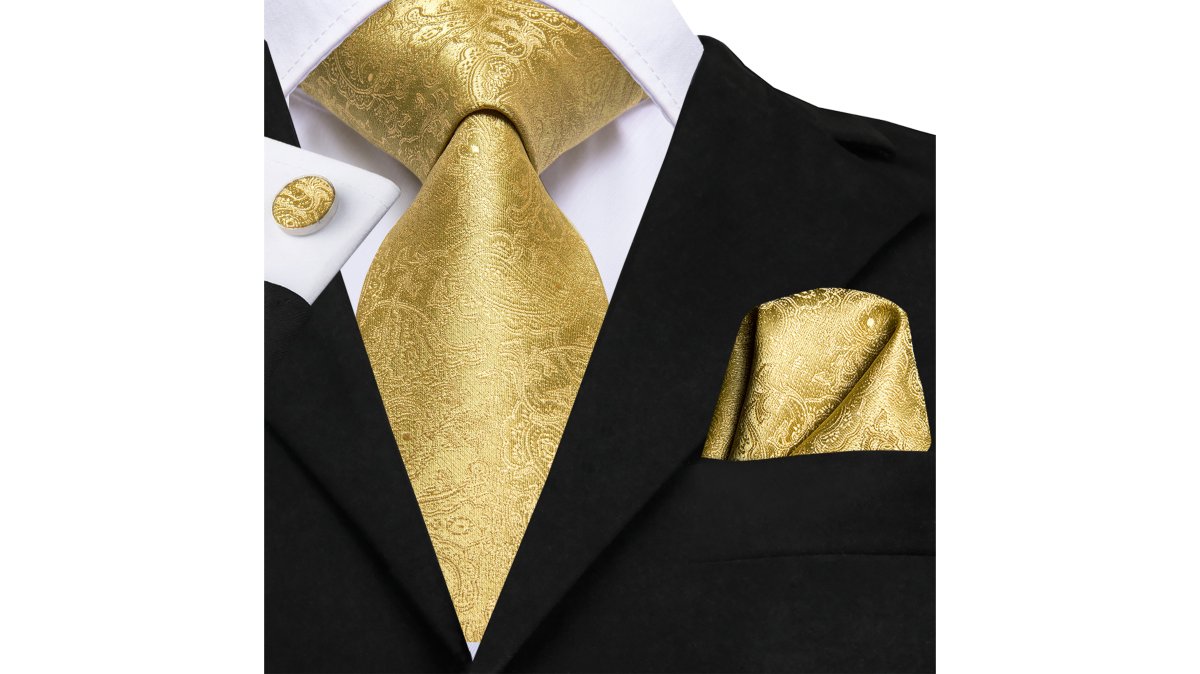
Paisley and floral patterns are statement pieces. When your tie features paisley, your pocket square should be solid or feature a complementary colour. The Gold Paisley Tie Pocket Square Cufflinks Set-DG-N-8773 demonstrates this principle. The paisley tie is paired with a coordinating pocket square that lets the tie's pattern be the focal point.
Wedding Suit Accessory Combinations and Styling
Weddings have their own rules for necktie and pocket square combinations. The formality level and colour palette of the wedding determine what works.
Red Silk Tie Pocket Square Cufflinks →
Formal Black-Tie Events
Black-tie weddings demand precision. Your tie should be a formal silk in black, navy, or a rich jewel tone; the pocket square should be white, cream, or a subtle shade that complements the tie. A black tie with a white pocket square is the safest choice; a navy tie with a cream pocket square is slightly warmer.
Business and Professional Occasions
Business occasions allow more flexibility. A navy tie with a subtle geometric pocket square works; a burgundy tie with a cream or gold pocket square is professional but warmer. Avoid loud patterns or colours that distract from business. SimonVon Shop's Golden Paisley Tie Pocket Square Cufflinks Set-N-3053 works well for business occasions where you want to show personality without crossing into casual.
Common Mistakes to Avoid When Pairing Ties and Pocket Squares
Most men make the same errors repeatedly. Matching too perfectly: A burgundy tie with a burgundy pocket square in the same fabric looks costume-like. Introduce variation in pattern or tone. Ignoring scale: A large-scale pattern tie with a large-scale pattern pocket square creates visual chaos. Clashing undertones: A warm gold tie with a cool silver pocket square creates tension. Forgetting the occasion: A bright neon pocket square looks out of place at a formal wedding. Choosing wrinkled fabric: A silk tie and pocket square should be crisp.
Building Your Formal Accessory Wardrobe
A strategic selection covers most occasions. Before you start buying, understand the difference between investment pieces and budget alternatives, and why sustainable sourcing matters for both your wardrobe's longevity and your values.
The Foundation: Neutral Pieces
Start with three neutral pocket squares: white, cream, and a soft grey. Add three ties in classic colours: navy, burgundy, and charcoal. These create nine different combinations across business, formal, and semi-formal occasions. Invest in quality silk for these foundational pieces.
Coordinated Sets for Certainty
Next, add coordinated sets for occasions where you want certainty. A paisley set or a patterned tie paired with a coordinating pocket square gives you a ready-made combination that's already been styled by professionals. For weddings, add a silk tie in a jewel tone (emerald, sapphire, or deep burgundy) and a white or cream pocket square.
Understanding Fabric Quality and Durability
Pure silk (100% silk) is the gold standard for formal wear. It drapes beautifully, holds colour well, and develops a subtle patina over time. Silk-blend ties (85% silk, 15% synthetic) offer slightly more durability and wrinkle resistance. Avoid 100% synthetic ties for formal occasions; they feel cheap and have a plasticky sheen.
Sustainable and Ethical Sourcing
Sustainable silk production matters because conventional silk farming relies on pesticides and water-intensive practices. Ethical silk sourcing, such as peace silk (where silkworms are allowed to complete their lifecycle) or silk from certified sustainable farms, costs more upfront but aligns with values-driven purchasing. Reputable retailers disclose whether their silk is conventionally sourced, certified sustainable, or peace silk.
Budget Versus Investment: A Practical Framework
Use this framework to decide where to splurge and where to save: Invest in pieces you'll wear frequently. If you attend formal events monthly or wear business formal daily, invest in quality silk ties and pocket squares in classic colours. Budget alternatives work for occasional wear. If you attend one or two black-tie weddings per year, a mid-range silk-blend tie is sufficient. Invest in coordinated sets if you're style-uncertain. A professionally curated set removes the guesswork. Budget on trendy colours; invest in classics. A navy, burgundy, or charcoal tie in quality silk is timeless. Invest in pocket squares; budget on ties. Pocket squares are visible, intimate accessories that signal attention to detail.
Storage and Care
Proper storage extends the life of your formal accessories significantly. Hang ties on a tie rack or roll them loosely to prevent permanent creases. Fold pocket squares and store them flat in a drawer, ideally with acid-free tissue paper to prevent yellowing. Keep ties and pocket squares away from direct sunlight, which fades colours over time.
Frequently Asked Questions
Should a necktie and pocket square match exactly?
They don't need to match exactly. The most sophisticated approach is to coordinate rather than duplicate: choose a pocket square that complements your tie's colour palette without being identical. A solid-coloured pocket square works beautifully with a patterned tie, or vice versa. The key is ensuring they share a common colour or tonal range so they appear intentional rather than mismatched.
How do I fold a pocket square for a professional look?
The presidential fold is ideal for business and formal occasions. Fold the square in half horizontally, then vertically, and adjust until a neat rectangular line shows above the pocket edge. The puff fold, where you gather the centre and let the edges billow slightly, works well for weddings and less formal events. Both styles keep your pocket square secure and visually balanced with your necktie.
What are good colour combinations for formal events?
Start with your suit's colour: charcoal or navy suits pair beautifully with gold, burgundy, or emerald accessories. For black-tie, stick to jewel tones or metallics. Complementary colours work best: if your tie is deep blue, choose a pocket square in silver, cream, or a lighter shade of blue. Avoid clashing patterns by keeping one piece solid if the other is patterned. Consider your skin tone too; warmer complexions suit gold and warm reds, whilst cooler tones work better with silver and cool blues.
Can I wear a pocket square without a tie?
Technically yes, but it's unconventional for formal occasions. Wearing one without a tie can look incomplete or overly casual for weddings, business meetings, or black-tie events. If you're attending a formal function, both pieces together create the polished, intentional look that defines proper formal attire.