
Which Dress Shoe Styles Are Essential for Formal Outfits?

Last Updated: October 25, 2026
Quick Summary
The essential dress shoe styles for formal outfits are the Oxford, the Derby and the loafer. An Oxford is the most formal shoe you can own, a Derby is the most versatile, and a loafer is the most comfortable for long events. Monk straps and dress boots come after these basics.
- Most wardrobes need two pairs of dress shoes, not five, to cover a wedding, a school ball and a client meeting.
- A black Oxford works with a dark suit, a dinner suit and a formal waistcoat and tie combination.
- A dark brown Derby handles business formal, semi-formal and smart-casual without looking out of place.
- Match your belt to your shoes as the fastest way to look put together, and it costs nothing.
- Try dress shoes on late in the day and do not buy them in the same size as your sneakers.
Table of Contents
- The Essential Dress Shoe Styles for Formal Outfits, Ranked
- The Types of Dress Shoes for Men Every Wardrobe Needs
- Oxford Shoes for Men: The Most Formal Pair You Can Own
- Formal Shoes for Men: Dress Codes Decoded
- How to Match Shoes with a Suit
- Women's Formal Shoe Styles for the Same Occasions
- Fit, Comfort and All-Day Wear: What to Check Before You Buy
- Build Your Formal Shoe Rotation at SimonVon Shop
- Frequently Asked Questions
The Essential Dress Shoe Styles for Formal Outfits, Ranked
The suit gets the attention, but the shoes decide whether the outfit looks finished.
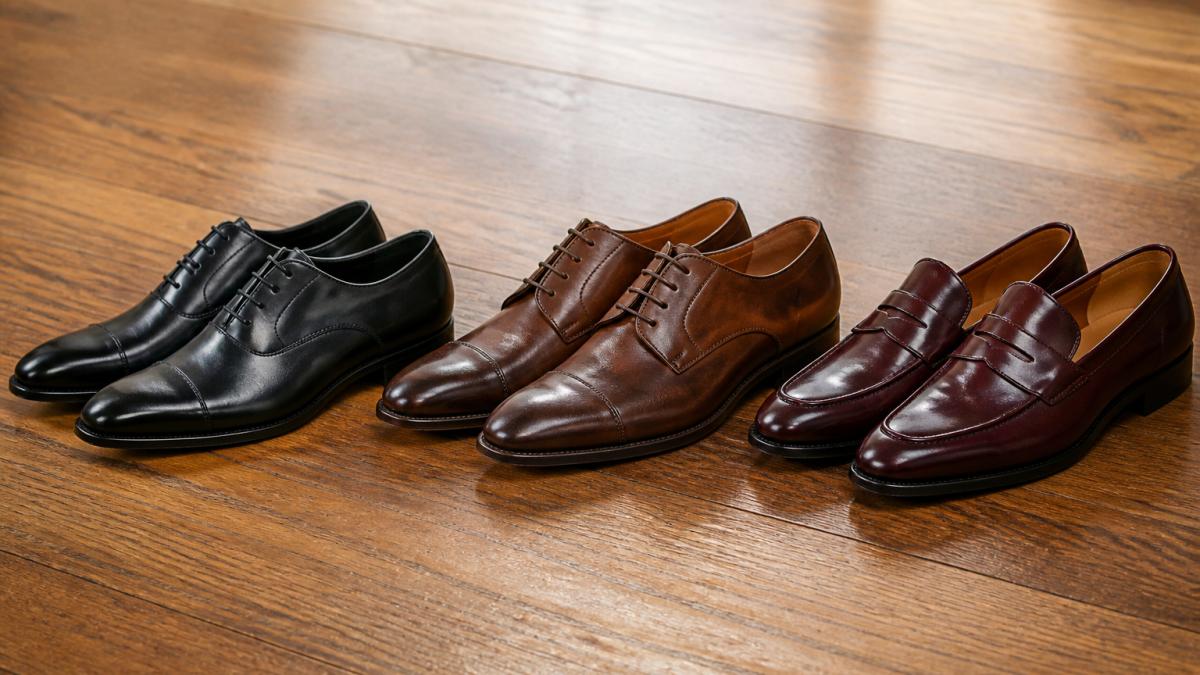
Here is the short answer: an Oxford is the most formal shoe you can own. A Derby is the most versatile. A loafer is the most comfortable for long events.
How to Use This Ranking
The ranking weighs formality, versatility and how often you will actually wear the pair. A shoe that works with one outfit ranks lower than one that handles three dress codes.
Use it as a buying order, not a wishlist:
- Oxford first if you own one suit and attend formal events
- Derby second if you want a pair that works for business and semi-formal
- Loafer third if your calendar includes long receptions or summer weddings
- Monk strap and dress boots last once the basics are covered
Most wardrobes need two pairs, not five. Get the first two right and they cover a wedding, a school ball and a client meeting.
The Types of Dress Shoes for Men Every Wardrobe Needs
The main types of dress shoes for men fall into five groups: Oxfords, Derbies, monk straps, loafers and dress boots. Each sits at a different point on the formality scale, which should drive your decision.
A quick rule: the more closed the lacing and the cleaner the lines, the more formal the shoe. Open lacing and visible stitching push a shoe toward casual.
Derby and Blucher Shoes
Derby and Blucher shoes are open-laced, with panels on top of the vamp rather than underneath, making them easier to get on and more forgiving across the instep.
A dark brown Derby handles business formal, semi-formal and smart-casual without looking out of place. The trade-off: it will never look as sharp as an Oxford at a black-tie event.
Monk Straps, Loafers and Dress Boots
Monk straps replace laces with a buckle. Single-monk styles lean formal, double-monk styles lean dressy-casual, and they suit anyone who wants something different from the rest of the room.
Loafers are slip-ons with no lacing. A leather penny or tassel loafer is the most comfortable formal option for a long day on your feet.
Dress boots, including the Chelsea boot, sit at the casual end. Wear them to a winter wedding or a smart dinner, not to a black-tie function.
| Style | Formality | Best For | Skip If |
|---|---|---|---|
| Oxford | Highest | Black tie, weddings, galas | You need one shoe for everything |
| Derby | High | Business formal, semi-formal | The event is strictly black tie |
| Monk strap | Medium-high | Weddings, dinners, receptions | You want maximum versatility |
| Loafer | Medium | Summer weddings, long events | The dress code is business formal |
| Dress boot | Medium-low | Winter events, smart casual | The invitation says black tie |
Oxford Shoes for Men: The Most Formal Pair You Can Own
Oxford shoes for men are the most formal style in the dress shoe family. The closed lacing sits under the vamp, creating one clean line from toe to ankle, which is why an Oxford pairs with a tuxedo and a Derby does not.
If you buy one pair for formal events, make it a black Oxford. To see which waistcoat styles complete a formal look, browse the guide to the best formal waistcoat styles.
Cap-Toe, Wholecut and Brogue Detail
Not all Oxfords are equal. The detailing changes how formal the shoe reads.
- Cap-toe Oxford: a seam across the toe. The safest formal choice.
- Wholecut Oxford: cut from one piece of leather. The cleanest, most formal look.
- Brogue Oxford: decorative perforations. Stylish, but less formal than a plain cap-toe.
A common mistake is wearing a heavily brogued shoe to a black-tie event. Brogue detail adds character but also casual weight, so keep the perforations for weddings and daytime formal events.
Formal Shoes for Men: Dress Codes Decoded
Formal shoes for men should match the dress code, not the other way around. Read the invitation first, then pick the shoe, black tie, business formal, cocktail and wedding guest codes each pull you toward different shoes.
Here is the decision sequence we recommend:
- Find the named dress code on the invitation. If none is named, default to the venue and time of day.
- Pick the formality tier using the table below.
- Choose the colour based on the suit you plan to wear, not in isolation.
- Check the detail level, brogueing, stitching and hardware should decrease as formality increases.
| Dress code | Shoe style | Colour | Detail level | Common mistake |
|---|---|---|---|---|
| Black tie / formal | Wholecut or plain cap-toe Oxford | Black, highly polished or patent | No brogueing, no visible stitching | Wearing a Derby or loafer because it is more comfortable |
| Business formal | Cap-toe Oxford or clean Derby | Black or dark brown | Plain or light brogueing | Overly casual loafers with a worsted suit |
| Cocktail | Monk strap, polished loafer or Oxford | Black, burgundy or dark brown | Subtle detail is fine | Dress boots that read too casual for evening |
| Semi-formal / smart | Derby, monk strap or loafer | Dark brown, burgundy or tan | Brogueing acceptable | Athletic soles or sneaker-style uppers |
| Wedding guest (daytime) | Derby, brogue Oxford or loafer | Brown, tan or burgundy | Brogueing welcome | Black patent shoes in daylight |
| Wedding guest (evening) | Oxford or polished loafer | Black or dark brown | Plain to light brogueing | Overly casual suede in a formal venue |
- Black tie is the strictest tier. A plain black Oxford in polished calf or patent leather is the safe choice. Brogue detail, chunkier soles and visible stitching push the shoe down the formality scale.
- Business formal is where the Derby earns its place. A dark brown Derby covers more ground than a second pair of Oxfords, though it will never look as sharp at a black-tie function.
- Cocktail and semi-formal codes are the monk strap's home turf. A single-monk in black or burgundy reads dressier than a loafer without the stiffness of a formal Oxford.
How to Match Shoes with a Suit
How to match shoes with a suit comes down to colour and contrast: match the shoe to the formality of the suit, then pick a colour that blends or deliberately contrasts.
Colour Rules That Actually Work
These rules hold up in practice:
- Navy or charcoal suit: black Oxford for formal, dark brown Derby for business
- Black suit: black shoes only. Brown clashes with black tailoring.
- Grey suit: black or burgundy. Burgundy adds warmth without looking casual.
One insider tip: match your belt to your shoes, the fastest way to look put together, and it costs nothing. If you are unsure whether a belt is needed, this guide on whether to wear a belt with a suit walks through the decision.
Patterned shirts are the other half of the equation. Bold checks and stripes look best with plain shoes, so let the shirt do the talking. Our guide to patterned dress shirts for formal events shows which patterns pair cleanly with formal footwear.
If you are assembling a full outfit, start with the trousers. A pair of solid suit pants with pockets in a matching tone gives you a clean line from waist to shoe.
Women's Formal Shoe Styles for the Same Occasions
Women's formal shoes follow the same logic as men's: match the shoe to the dress code, then to the outfit. The styles below cover the same events.
- Pumps: the closest equivalent to an Oxford. A closed-toe pump in black or nude works for black tie, weddings and business formal.
- Slingbacks: formal but lighter. Good for semi-formal and summer events.
- Mules: backless and easier to wear. Best for receptions and business casual.
The same colour rules apply. Black and nude cover the most ground. Metallics work for evening events but are harder to repeat.
Fit matters more here than most guides admit. A pump that pinches at the heel will ruin a long reception, so try shoes on late in the day when your feet are at their largest.
Fit, Comfort and All-Day Wear: What to Check Before You Buy
Fit is where most formal shoe purchases go wrong. A beautiful pair that hurts by the second hour will sit in the wardrobe forever, and no amount of polishing fixes a shoe that does not fit your foot shape.
Diagnose the fit before you commit
Try shoes on late in the day, when your feet are at their largest, and wear the socks you plan to pair with them. Then run these checks:
- Heel slip: a small amount is normal in new leather and will settle as the shoe breaks in. More than a finger's width of lift means the shoe is too big, and no insole will fully fix it.
- Toe room: you should be able to wiggle your toes without pressure on the top of the foot. If the top of your toes brushes the upper, size up.
- Width at the widest point: if the shoe pinches across the ball of your foot, sizing up in length will not solve it, you need a wider fit. Many dress shoe brands offer a standard and a wide last.
Construction affects comfort more than cushioning
Comfort over a four-hour event is decided by how a shoe is built, not by how soft the leather feels in the shop.
- Leather type: full-grain leather lasts longer, creases more gracefully and polishes better than corrected-grain, which is more uniform and easier to clean but tends to crack where it flexes.
- Sole construction: a Goodyear-welted sole can be repaired and reshaped by a cobbler; a glued sole cannot. If you plan to wear the same pair for years, construction quality matters more than any single detail on the upper.
- Lining: a leather lining breathes better than a synthetic one, which matters on long evenings indoors.
All-day wear tactics for long events
If you will be on your feet from ceremony to reception, a few habits make a bigger difference than the shoe itself:
- Rotate pairs. Wearing the same pair two days running stops the leather drying out between wears, which shortens its life.
- Use shoe trees. Cedar trees absorb moisture and hold the shape of the shoe between events.
- Carry a spare pair of socks for long summer events, a fresh pair mid-evening resets comfort more than you would expect.
Get the fit and construction right and the shoe disappears from your attention, exactly what you want at a formal event.
Build Your Formal Shoe Rotation at SimonVon Shop
A formal shoe rotation does not need to be expensive. Two well-chosen pairs cover almost every invitation, and one good pair beats five cheap ones.
At SimonVon Shop, we stock premium quality menswear at prices that make building a full formal outfit realistic. If you are ready to put an outfit together around your shoes, our dark violet classic suit set gives you a complete starting point.
Every piece is chosen to work together, so you can build a rotation without guessing what matches.
Frequently Asked Questions
Are Oxfords or Derbies more formal?
Oxfords are the more formal of the two. Their closed lacing gives a cleaner, sleeker line that suits black tie, weddings and business formal. Derbies have open lacing and a slightly roomier fit, which makes them better for semi-formal events, business casual and anyone with a wider foot. If you own one pair of dress shoe styles for strict formal wear, make it a black cap-toe Oxford.
Can you wear brogues with a formal outfit?
Yes, with care. Brogue detailing adds character, but the more perforations a shoe has, the less formal it reads. A dark brown or black cap-toe Oxford with light brogue detail works for weddings and business formal. Heavily patterned wingtips suit semi-formal and business casual better. Keep the rest of the outfit simple so the shoes stay a detail, not the main event.
What colour dress shoes go best with a navy suit?
Dark brown is the safest match for a navy suit and works across weddings, business formal and semi-formal events. Black is sharper for evening and black-tie-adjacent occasions. Burgundy adds warmth and pairs well with navy for gala and race-day outfits. Match your belt to your shoes, and keep the leather finish consistent, so polished shoes go with a polished belt.
How do I match shoes with a suit for a wedding or school ball?
Start with the dress code, then work backwards. Black tie calls for polished black Oxfords. Formal and semi-formal weddings suit black or dark brown Oxfords and Derbies. For a school ball, a pair of clean black Derbies or loafers pairs well with a slim suit and waistcoat. Match leather colour to your belt, keep socks dark, and break the shoes in a week before the event.
Building a formal wardrobe takes a few good decisions, not a big budget. Start with one pair of black Oxfords, add a dark brown Derby, and you can handle a wedding, a school ball and a client meeting with the same two shoes. SimonVon Shop stocks premium menswear and formal accessories at prices that make the full outfit achievable, including waistcoats, vest sets, ties and pocket squares. Get started with SimonVon Shop and build a formal rotation that looks sharp at every event on your calendar.
